Restaurant customer retention decides whether a food business grows on its own or keeps paying for every order. This playbook is for owners of restaurants, cloud kitchens, cafes, tiffin services and home bakeries in India who already get first orders, from delivery apps, Instagram, walk-ins or a neighbour's recommendation, and watch too many of those customers disappear after one meal. By the end you will have your retention numbers written down, a second-order routine that runs every Monday, a rating loop that catches a bad order the same evening, a customer list split by order history, a loyalty reward and a referral offer that run on WhatsApp without an app, and a win-back sequence for the customers who drifted. The one belief it will change is that retention needs a big budget, a custom app or a CRM. It needs a list of who ordered and when, a few messages sent on a fixed rhythm, and someone who reads five numbers every week. Every chapter ends with a checklist. Every rupee figure is illustrative, built from typical numbers rather than any named merchant, so replace each one with your own.
Chapter 1: Know your retention numbers before you change anything
Most owners can tell you yesterday's sales to the rupee and have no idea how many of last month's new customers came back. That is why retention work usually fails: a coupon goes out, orders rise for a weekend, and nobody can say whether anything changed. Before you send a single message, write down where you stand.
Retention can only be measured on customers you can identify. Delivery app orders arrive with masked numbers and no history, so your numbers come from your own WhatsApp number, your store page, and dine-in or phone orders where you captured a number. If that is a small share of your orders today, start with the capture steps in Chapter 2.
The five numbers that describe retention
| Number | How to calculate it | What a weak result tells you |
|---|---|---|
| Second order rate | Last month's first-time customers who ordered again within 30 days, divided by all of last month's first-time customers | The first experience or the follow-up is not working |
| 90-day retention | Customers whose first order was three months ago and who ordered in the last 30 days, divided by that month's first-time customers | People try you, but no habit forms |
| Repeat order share | Orders from customers with at least one earlier order, divided by all orders on your channel | You depend on constant acquisition |
| Orders per active customer | Orders in the last 90 days, divided by customers who ordered in that period, divided by three | Regulars order less often than they could |
| Lapsed regulars | Customers with two or more orders whose last order is older than your lapse threshold from Chapter 4 | This is your win-back list, and its size is money waiting |
Write each number down with today's date and recalculate on the first of every month. The direction matters more than the level. Measure by monthly cohort, meaning everyone whose first order fell in the same month, rather than as one blended figure. A blended repeat share rises when retention improves, and it also rises when you stop winning new customers. Cohorts give you a fair test too: if the second-order routine starts on 1 December, compare the December cohort with November's. The restaurant customer retention guide explains why customers drift; this playbook is the execution plan.
What one repeat customer is worth
Lifetime value is the profit a customer brings over the months they keep ordering. Take an illustrative ₹350 order with ₹130 of food, ₹15 of packaging and ₹35 of delivery. That leaves ₹170, and after a flat ₹10 platform fee on a direct order you keep ₹160. A regular who orders twice a month for eight months is worth about ₹2,560. The same customer ordering through a delivery app at 25 percent commission leaves about ₹82 an order, or ₹1,312 over the same eight months.
The levers are easy to see. Move the regular from two orders a month to two and a half and the value rises to ₹3,200. Keep them for ten months instead of eight and it rises to ₹3,200 again. Do both and it reaches ₹4,000. Seen this way, a ₹50 coupon that brings back a drifting regular is cheap, and a first-order discount that brings in customers who never return is expensive. The full calculation is in customer lifetime value for restaurants.
The leaky bucket in rupees
The table follows 100 first-time customers acquired in one month, each of whom cost about ₹150 to win through ads, a first-order discount or an app's commission. Those who come back place one further order a month for six months, at ₹160 kept per direct order. Only the second order rate changes between the columns.
| Per 100 first-time customers, over six months | 15 percent come back | 25 percent come back | 35 percent come back |
|---|---|---|---|
| Customers who place a second order | 15 | 25 | 35 |
| Repeat orders at six each | 90 | 150 | 210 |
| Repeat revenue at ₹350 | ₹31,500 | ₹52,500 | ₹73,500 |
| Kept after food, packaging, delivery and the ₹10 fee | ₹14,400 | ₹24,000 | ₹33,600 |
| Cost of acquiring the 100 | ₹15,000 | ₹15,000 | ₹15,000 |
| Result after six months | Minus ₹600 | Plus ₹9,000 | Plus ₹18,600 |
At 15 percent, the cohort does not even repay what it cost to win. At 35 percent, the same kitchen with the same ads earns back more than twice its acquisition spend. That is why the rest of this playbook is about what happens after the first order.
Checklist: your baseline
- Pull every order from your own channels for the last 90 days with phone number, date and value.
- Calculate the five numbers and write them down with the date.
- Work out what share of all orders come from channels where you can see the customer. If it is under a third, start with capture.
- Estimate your lifetime value with your own order value, food cost and frequency.
- Name one person who owns the Monday sitting for the next 13 weeks.
Chapter 2: Win the second order
The second order is the hardest one a customer places. The first was usually bought with a discount, an ad or a friend's recommendation. The second has to happen on its own, on the strength of the food, the delivery and whether the customer can find you again. Once it happens, the third and fourth come far more easily, because the customer has a habit and your number in their chats. The reasoning is in first order to second order; this chapter turns it into a weekly routine.
Capture the customer on every first order
You cannot invite back someone you cannot reach. Orders on your WhatsApp number or store page capture the number automatically. Delivery app orders give you nothing, so the bag does the work: a card with a QR code that opens a chat with your number, one line on why to order direct, such as free delivery above ₹349, and your store link. Your packaging is yours, but never message anyone using a number you only saw because of an app order. Dine-in guests get the same QR on the table and the bill, and phone orders end with your store link sent on WhatsApp.
Then ask for permission to send offers, once, in the chat, right after the first order is confirmed:
Order confirmed, [Name]. Would you like our weekly specials on WhatsApp, about once a week? Reply YES to join. Reply STOP any time to leave.
Wording that keeps you inside Meta's policy and India's data protection rules is in WhatsApp opt-in without annoying customers. The opted-in list you build here is the asset every later chapter runs on.
Audit the first experience
No reminder rescues a cold first order. Order from your own channel the way a stranger would, on a busy evening, to an address near the edge of your zone. Check that a confirmation arrived within a minute with an honest time and the delivery charge shown, that status messages followed, that the food arrived hot and complete, and that the card was in the bag. Then check the reorder: best sellers at the top of the menu, a short checkout, your store link sitting in the chat. Fix any failure before the messages below go out. More ways to cut friction are in how to get repeat orders.
The second-order routine, run as a Monday batch
Run this in one sitting a week. Every Monday, look at everyone whose first order fell in the week before last and who has not ordered again. They are 8 to 14 days past their first order, roughly when a customer who enjoyed the meal starts thinking about you again, and they all get the same message in one send.
| Touch | When | What it says | How it is sent |
|---|---|---|---|
| Confirmation and status updates | During the first order | Items, total, honest time, then preparing, out for delivery, delivered | Automatically |
| Rating request | After the order is marked delivered | How was it, tap a rating | Automatically; low ratings go to Chapter 3 |
| Second-order nudge | Monday batch, 8 to 14 days after the first order | Thank you, one popular dish, an offer valid for 10 days | One campaign to the batch |
| Offer reminder | The following Monday | The offer ends on Wednesday | One campaign to those who have not used it |
Hi [Name], thanks for trying [Restaurant] last week. Our most ordered dish this month is the [dish], if you would like something new. Here is ₹50 off your next order above ₹300 with code AGAIN50, valid till [date]: [store link]. Reply STOP to opt out.
The reminder is two lines saying the code ends on Wednesday. The customer leaves the routine the moment they order again; after the reminder they join the one-and-done segment in Chapter 4. Send between 11 am and 7 pm, before the meal people order you for, and if most customers write to you in Hindi, send the messages in Hindi.
Size the second-order offer so it pays
The risk with any second-order coupon is handing it to people who were coming back anyway. Illustrative numbers for a batch of 100 first-time customers, at ₹160 kept per order:
| Line | Plain nudge, no offer | Nudge with ₹50 off above ₹300 |
|---|---|---|
| Customers who place a second order | 18 | 26 |
| Coupon cost | ₹0 | ₹1,300 |
| Of which went to people who would have returned anyway | ₹0 | ₹900 |
| Extra second orders the coupon bought | None | 8, keeping ₹1,280 |
| Kept if those 8 then order five more times each | None | ₹6,400 more |
On the second order alone, the coupon roughly breaks even. It pays because the extra customers it brings back go on to become regulars. So set a minimum order, use the code only in this routine so it reaches first-timers and nobody else, and keep the deadline short, because the deadline moves people more than the size does. Free delivery works as well as a flat discount for most delivery kitchens. To test it for yourself, split the Monday batch for four weeks, half with the coupon and half without, and compare the two second order rates. If the gap is small, drop the coupon and keep the nudge.
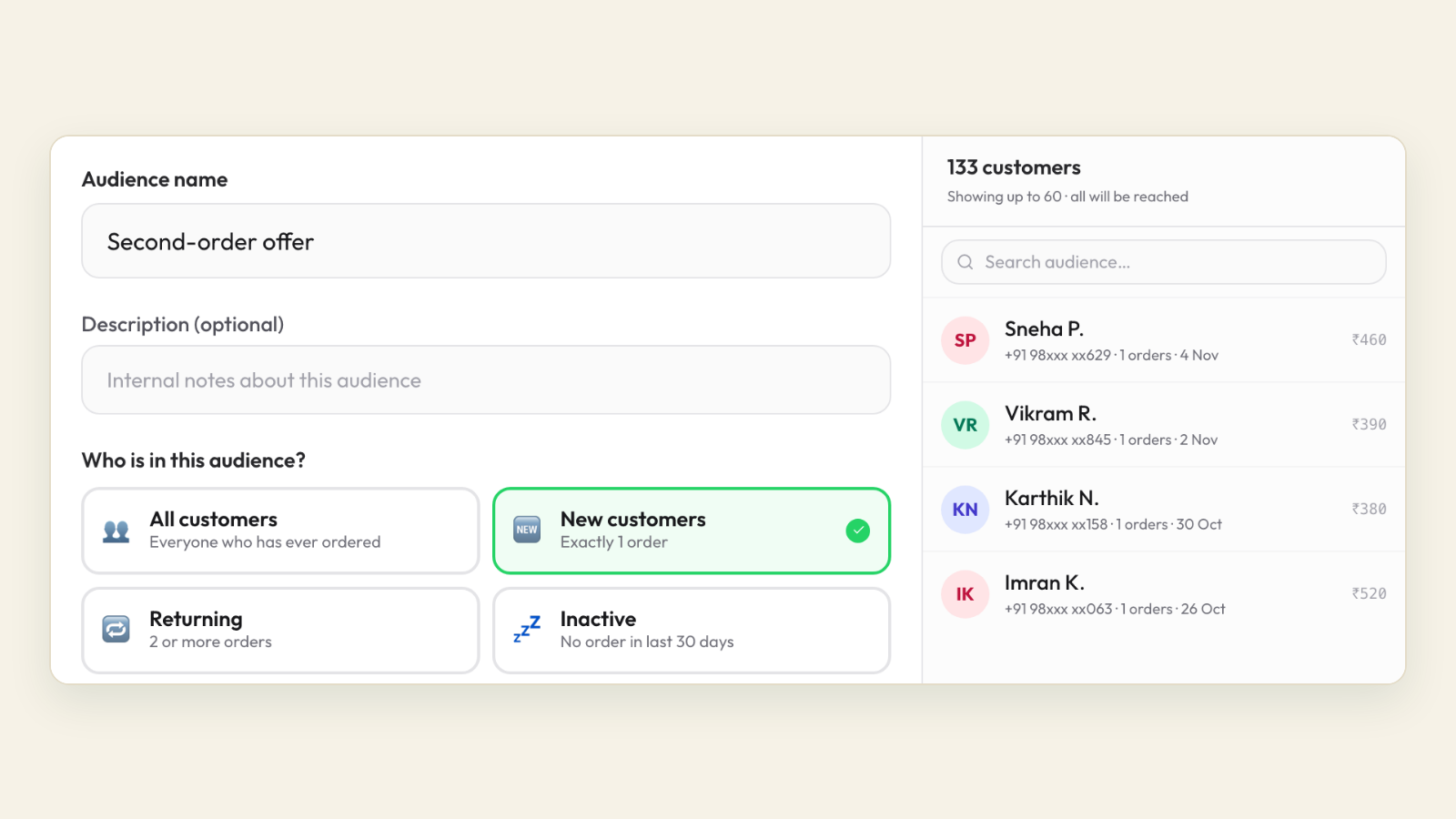
On Tezzu, orders arrive on your own WhatsApp number and your free store page, so every first-time customer is in the live dashboard from the first order, and the customer insights view shows who has ordered once and who has come back. Coupons take a minimum order, a cap for percentage offers and an end date. An auto-apply coupon applies for everyone who meets its rules, so use auto-apply for offers every qualifying customer should get, such as a welcome discount limited to first orders, and keep segment offers like AGAIN50 as a code that appears only in the message. The nudge and reminder go out as WhatsApp campaigns to the customers you choose, paid from a prepaid wallet, with nothing charged for undelivered messages.
Checklist: the second-order system
- A card with your QR, number, offer and store link goes into every bag, delivery app orders included.
- The opt-in question goes out after every first order.
- Your own test order passed the first-experience checks.
- The Monday batch is in the calendar with a named owner.
- The offer has a minimum order, an end date and a code used nowhere else.
- The four-week split test is planned and will be read at the 30-day review.
Chapter 3: Build the feedback and review loop
Customers rarely complain. They drift. The biryani was cold on Thursday, nobody said anything, and the customer never ordered again. A rating request after every order is how you hear about Thursday while you can still act. It also produces a list of what your kitchen keeps getting wrong and a steady flow of happy customers to ask for a public review. The case for collecting it automatically is in automated feedback collection after every order.
One rating first, one question second
The first message asks for a rating and nothing else, one tap, in the chat the customer ordered from, after the food has been eaten: 30 to 60 minutes after delivery, about an hour after pickup, the next morning for dine-in and late-night orders, and weekly for tiffin subscribers. Send it once and do not chase. The follow-up depends on the answer, and the follow-up is where the value is.
Route every answer to a person and an action
| Rating | Who acts | How fast | What they do |
|---|---|---|---|
| 1 or 2, or any written complaint | Owner or manager | Within the hour, during opening time | Call or message personally, apologise for the specific thing, offer a remake or a credit on the next order, log the cause |
| 3 | Manager | Same day | Ask one question: what would have made it a 5? Log the answer |
| 4 | Anyone on shift | Same day | A short thank you |
| 5 | Anyone on shift | Same evening | Thank you and your Google review link; a referral ask a few days later |
The call after a low rating is the most valuable single retention action in this playbook. A customer who gets a prompt, specific apology often becomes a regular because of it; a customer with no easy way to complain often becomes a one-star public review. Keep it short and concrete:
Hi [Name], this is [Owner] from [Restaurant]. I am sorry the dal makhani arrived cold tonight. Your next order has ₹100 off, and I am checking the packing for your area myself this week.
Agree the credit or remake in advance so the person on shift can offer it without calling the owner. Scripts for missing items, late delivery and refund requests are in handling order complaints on WhatsApp.
The weekly cause tally
Every low rating gets one cause written against it: late, cold, wrong or missing item, taste, portion, packaging or rider. Count them on Monday. Patterns appear within a few weeks, and each points at a fix in the kitchen or the delivery setup.
- Several "cold" ratings from one zone: the trip is too long for that food. Change the container, tighten the zone or raise the charge there.
- "Late" with no complaint about the food: the promised time is wrong. Add ten minutes to the estimate.
- One dish pulling 3s while the rest get 5s: taste it after 30 minutes in a box, the way the customer eats it, and fix the recipe or the packaging.
Turn happy customers into public reviews
A customer who just tapped 5 is the easiest person to ask for a Google review. Thank them the same evening and send your review link. Ask only the 5s, because asking a 3 invites a public 3. Never offer a discount for a review; Google's policies do not allow incentivised reviews. Wording and timing are in how to get more Google reviews for your restaurant.
What the loop is worth
Take an illustrative kitchen with 600 direct orders a month that gets 150 ratings back. Twelve are a 1 or a 2. The owner calls all twelve the same evening and gives each a ₹100 credit. Suppose half order again and stay for eight more orders: 48 orders at ₹160 kept is about ₹7,680, against ₹600 in credits and twelve phone calls. Without the calls, the likely outcome is twelve customers gone.
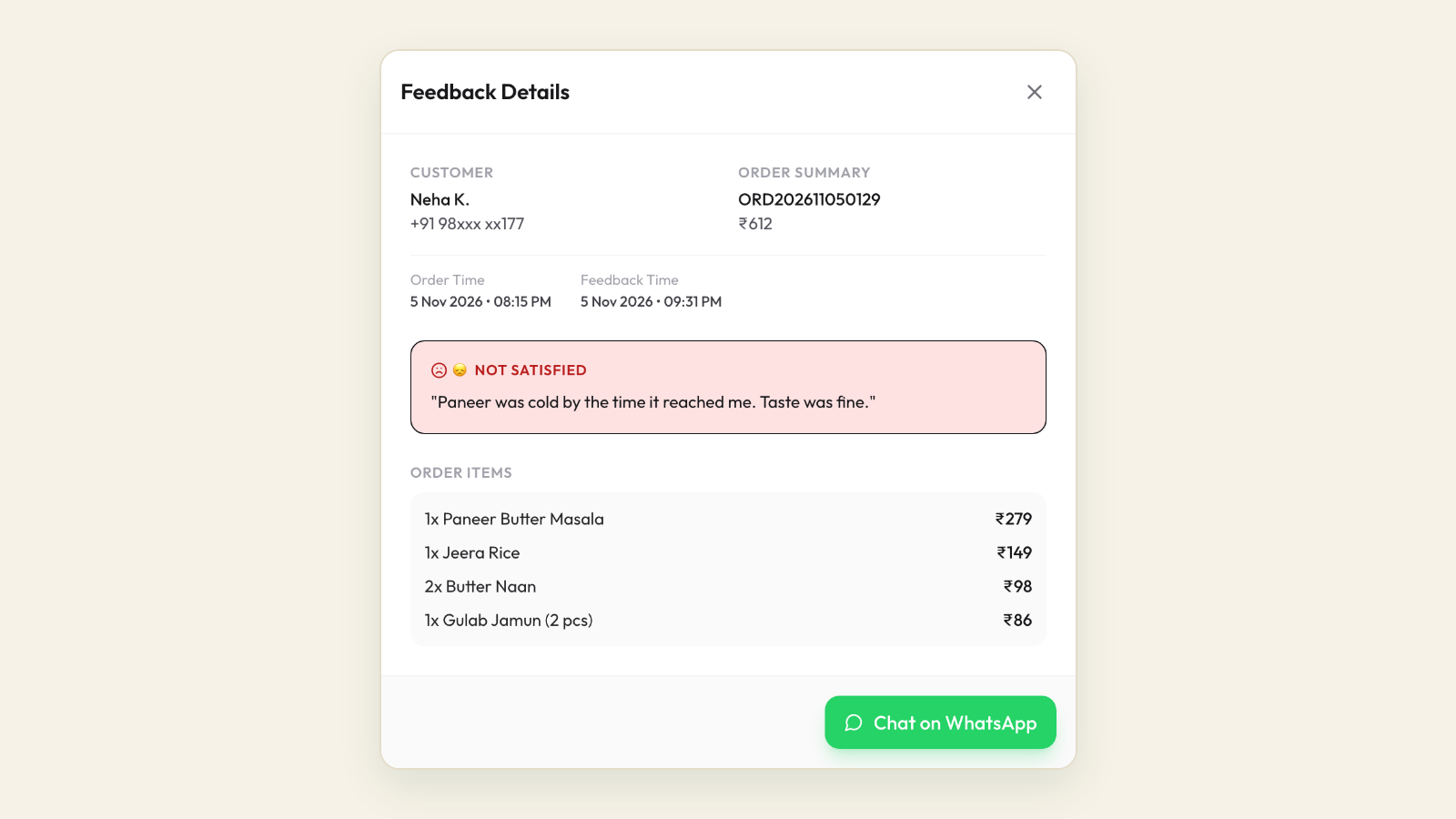
On Tezzu, order reviews are built in. Once switched on, every order that reaches its final status, delivered, collected at a pickup point or served at the table, triggers a rating request on WhatsApp from your own number. The rating and any comment sit on the order and against the customer, so a low score shows exactly what was in the order and who to call, and you can spot a regular who has given two 3s in a row. Staff with the right permission can read ratings too, so the kitchen lead sees "paneer was cold" the same day. The setup is in collecting ratings after every order with Tezzu reviews.
Checklist: the feedback loop
- Rating requests go out after every direct order, tied to the final status.
- Staff mark orders delivered when they are delivered, not at dispatch.
- A named person owns low ratings on every shift, with a one-hour reply rule.
- The credit or remake for a bad order is agreed in advance.
- The cause tally is read every Monday and one fix is chosen.
- 5-star raters get the Google review link the same evening, with no discount attached.
Chapter 4: Segment customers by order history
Once your list passes a couple of hundred customers, one broadcast to everyone starts costing you money. The discount reaches regulars who would have paid full price, the lapsed customer ignores an offer written for someone who ordered yesterday, and every irrelevant message raises the chance of a block, which on the WhatsApp Business API lowers your number's quality rating and can limit how many people you may message. Splitting the list by order history fixes all three. The method, including the recency, frequency and spend scoring behind it, is in restaurant customer segmentation.
Six segments are enough
| Segment | Definition, delivery kitchen example | What to send | Offer |
|---|---|---|---|
| New | First order in the last 14 days | The Chapter 2 nudge and reminder | Second-order code |
| One-and-done | One order, 15 to 60 days ago | A different dish and an honest question | Free delivery, once |
| Regular | Two or more orders in the last 30 days | New dishes, weekday specials, loyalty progress | None; rewards come from the loyalty program |
| High value | Top fifth of customers by spend in the last 90 days | A personal note from the owner, early access to festival menus | None, or a bundle built around what they order |
| Slipping | Was a regular, quiet for 21 to 45 days | What is new, with a small offer | ₹50 off or free delivery, short expiry |
| Lapsed | Was a regular, quiet for more than 45 days | The Chapter 6 sequence, then stop | Rising across three messages |
As the list grows, keep occasion buyers, whose single order was three or more times your average, for party and festival pre-order messages, and keep dine-in guests apart from delivery customers.
Set the thresholds from your own order cycle
"Quiet for 45 days" is an emergency for a tiffin service and perfectly normal for a cake shop. Set thresholds from how often your regulars actually order. These are illustrative starting points.
| Business | Typical gap between orders | Regular means | Slipping after | Lapsed after |
|---|---|---|---|---|
| Tiffin or daily meals | 1 to 2 days | Four or more orders a week | 7 days | 21 days |
| Cloud kitchen, delivery | 7 to 14 days | Two or more orders a month | 21 days | 45 days |
| Cafe, dine-in and takeaway | 7 to 21 days | Two or more visits a month | 30 days | 60 days |
| Home bakery, occasion cakes | 2 to 6 months | Two or more orders a year | 6 months | 12 months |
The monthly one-hour refresh
- On the first of the month, list each customer's last order date, orders in the last 90 days and spend in the last 90 days. A spreadsheet works up to a few thousand customers.
- Assign every customer to one segment. If someone fits two, the more specific one wins: a lapsed high-value customer gets a personal note from the owner, not the lapsed template.
- Plan the month's sends: which segment hears what, in which week, with which offer and which code.
- Check the cap. No customer gets more than one marketing message a week across all segments. Confirmations, status updates and rating requests do not count.
A month of sends for a 1,200-customer list
| Segment | Customers | Sends this month | Offer | Messages |
|---|---|---|---|---|
| New | 120 | Nudge and reminder | ₹50 off above ₹300, 10 days | 240 |
| One-and-done | 260 | One message | Free delivery, 7 days | 260 |
| Regular | 300 | A new dish, then a referral ask | None | 600 |
| High value | 80 | One personal note | Early festival menu | 80 |
| Slipping | 140 | Offer, then reminder | ₹50 off, 5 days | 280 |
| Lapsed | 300 | First win-back message | None yet | 300 |
| Total | 1,200 | Nine sends | Discounts to 520 customers | 1,760 |
This illustrative split assumes 1,200 opted-in customers. At the rates Meta has published for India, a marketing message costs less than a rupee, so the month's wallet spend stays under ₹1,800 and discounts reach only the 520 customers who need a push. The common alternative, 10 percent off to all 1,200 every Friday, sends 4,800 messages a month and hands a weekly discount to 380 regulars and high-value customers who would have ordered anyway.
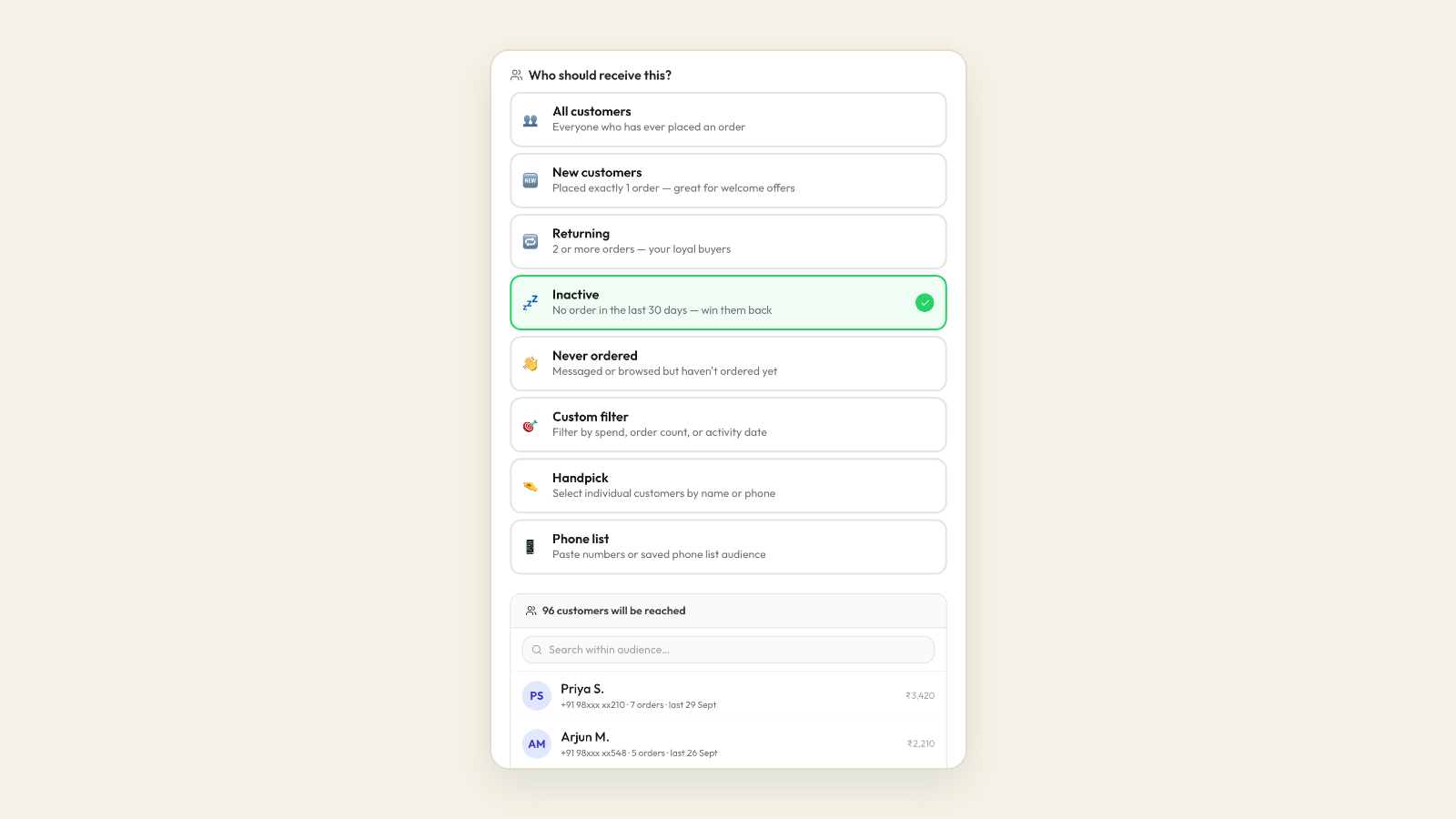
On Tezzu, every WhatsApp and store-page order lands in one dashboard, so order dates, counts, values and items are already recorded, and the customer insights view shows who orders, how often and what they spend. Campaigns let you choose the audience for each send, pick an approved template and send now or schedule it, so the slipping message and the regular message are two separate campaigns from the same wallet. Every order records the coupon used, which is how you read each segment's response.
Checklist: segments
- Thresholds set from your own order cycle and written down.
- Every customer assigned to one of six segments on the first of the month.
- One code per segment offer, so each group's response is visible.
- Regular and high-value customers excluded from every discount send.
- A cap of one marketing message per customer per week.
Chapter 5: Run a loyalty program without an app
Nobody downloads a restaurant's app to collect points, and paper stamp cards get lost. The loyalty programs that work for an independent food business can be explained in one line, tracked from a customer list and delivered as a coupon on WhatsApp. They only work on orders you can count, which is one more reason to make the reward direct-only and print it on the card that goes into app orders. Formats and messages are laid out in restaurant loyalty program on WhatsApp; this chapter is about the threshold and the maths.
Pick one format
| Format | Rule in one line | Suits | Watch out for |
|---|---|---|---|
| Order-count reward | Every fifth direct order gets a free dessert | Delivery kitchens and cafes with frequent orders | Needs an order count per customer and a time limit |
| Prepaid pass | Pay ₹1,500 for 12 lunches worth ₹1,800 | Tiffin services and office lunch kitchens | You owe the meals, so track every redemption |
| Spend tier | Spend ₹3,000 in a quarter, get 10 percent off next quarter | Family restaurants with larger bills | Harder to explain; needs a quarterly review |
| Surprise reward | Random regulars get a free dessert with a thank-you note | Any format, as a layer on top | Builds goodwill more than habit |
For most single-outlet restaurants and cloud kitchens, the order-count reward is the right first program. Run one format at a time.
Set the threshold from your regulars' frequency
A typical regular should reach the reward within six to eight weeks. If your regulars order three times a month, every fifth order works. If they order once a month, five orders is five months away and most will forget the program exists, so use every third order or a spend-based reward. The reward should feel generous at menu price and cost little at food cost: a dessert, a starter, a drink, or ₹100 off an order above ₹400.
The maths of a reward
An illustrative program on a ₹350 average order: a customer who reaches the reward has spent ₹1,750. A free gulab jamun with a ₹90 menu price and a ₹25 food cost gives back about 1.4 percent of that spend. The same five orders on a delivery app at 25 percent commission would have cost you about ₹440.
The cost to watch is rewarding people for what they already do. Suppose 100 regulars join and their frequency moves from 2.0 to 2.3 orders a month. That is 30 extra orders, about ₹4,800 kept. The rewards cost 46 desserts a month, which is 230 orders divided by five, at ₹25 each, about ₹1,150. The program earns roughly four times its cost. If frequency does not move, the same ₹1,150 is a pure discount to people who would have ordered anyway, and you should raise the threshold or change the reward.
Progress messages do most of the work
A program nobody can see does not change behaviour. Tell customers the rule in a welcome line after their first direct order, then send the message that matters most and is most often skipped, the one after the third order:
That was your third order with us, [Name]. Two more and the gulab jamun is on us. This week's special is [dish]: [store link]
You made it, [Name]. Your next order includes a free gulab jamun. Use code [CODE] before [date] on any order above ₹300.
In the Monday sitting, customers who crossed three orders get the progress message, those who crossed five get the reward code, and anyone with a two-week-old unused reward gets one reminder. Once a month, compare members' order frequency in the 60 days before and after they joined. That comparison tells you whether the program changes behaviour or just gives food away.
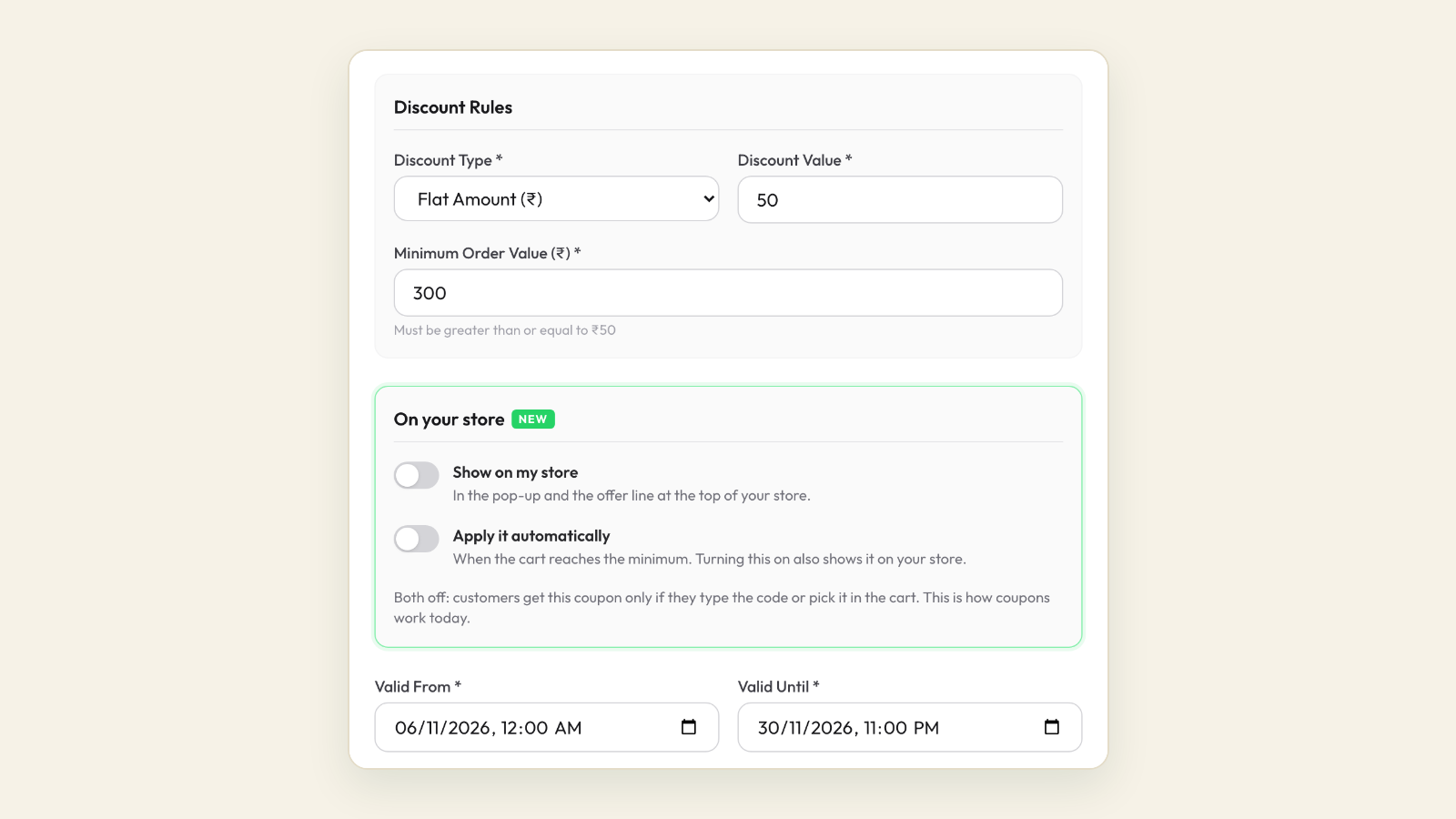
On Tezzu, the customer insights view shows each customer's order count, and the reward is a coupon with a minimum order and an end date, sent only to the customers who earned it as a small campaign. For a reason to come back between rewards, menu scheduling by weekday lets you run a Tuesday-only dish without editing the menu each week, and bundles turn a regular's usual order into one tap.
Checklist: loyalty
- One format chosen and written as a single sentence.
- Threshold set so a typical regular reaches the reward within six to eight weeks.
- Reward chosen with a low food cost, a minimum order and an expiry.
- Rule printed on the bag card and in the welcome line.
- Weekly count added to the Monday sitting.
- Member frequency compared before and after joining, every month.
Chapter 6: Win back customers who stopped ordering
A customer who ordered eight times and then went quiet has already shown that they like your food. Most did not leave angry. They forgot, or another restaurant appeared first on a busy evening, or the last order disappointed them and nobody asked. A short sequence brings back a share of them. The rest you let go, cleanly.
Find out why before you write the message
Look at the last rating each lapsed customer gave. Anyone whose last order was a 1, 2 or 3 should get a personal message from the owner, not a template with a coupon. For the rest, a reminder and a small reason to act is usually enough. If you have no ratings to go on, the ways to find the reason are in why customers stop ordering.
The three-message sequence
| Message | When | What it says | Offer |
|---|---|---|---|
| 1. Soft check-in | Day 0 | What they used to order, and one thing that is new | None |
| 2. The offer | Day 14, to those who did not order | A specific reason to come back this week | ₹50 off above ₹300, valid five days |
| 3. The last message | Day 42, to those who still did not order | Says plainly that it is the last offer for a while | Free delivery, valid three days |
Hi [Name], it has been a while since your last paneer butter masala from [Restaurant]. We added a weekday lunch combo at ₹199 this month. Reply "menu" to see it, or order at [store link].
Hi [Name], we would like to have you back. Use code BACK50 for ₹50 off your next order above ₹300, valid till Sunday: [store link]. Reply STOP to opt out.
Hi [Name], this is our last offer message for a while. Code LASTFREE gives you free delivery for the next three days. Reply STOP and we will take you off our offers list.
A customer who orders at any point leaves the sequence and returns to the regular segment. After message 3, everyone who did not respond comes off the marketing list, because more messages turn a win-back into block reports that hurt the number your current customers order on. Start with free delivery or a flat amount with a minimum; avoid 30 to 50 percent off, which teaches customers that going quiet is how you get discounts. Thresholds by business type and the sending rules are in WhatsApp win-back campaigns.
What a win-back sequence returns
An illustrative run on 300 lapsed regulars, with a ₹350 average order and ₹160 kept per order:
| Step | Messages | Orders | Offer cost |
|---|---|---|---|
| Message 1, no offer | 300 | 12 | ₹0 |
| Message 2, ₹50 off | 288 | 15 | ₹750 |
| Message 3, free delivery at about ₹40 to you | 273 | 9 | ₹360 |
| Total | 861 | 36 | ₹1,110 |
The 36 orders keep about ₹5,760. Take off ₹1,110 in offers and under ₹861 in messages and the sequence clears roughly ₹3,800 on the comeback orders alone. If a third of those customers settle back into ordering, 12 customers placing six more orders each is another ₹11,520. Notice that message 1, with no offer at all, brought back a third of the orders. Many lapsed customers only needed reminding.
The 60-day check
Sixty days after message 1, look again at everyone who came back. A customer who used the code once and vanished cost you a discount and little else. A customer who has placed three full-price orders since is the whole point. If most comebacks are one-off coupon orders, the problem is upstream, in the food, the delivery time or the price, and the Chapter 3 ratings will show which.
Win-back messages go to people who have not written to you in weeks, so on the WhatsApp Business API they go out as approved templates, and only to customers who opted in. On Tezzu, you choose the lapsed customers as the campaign audience, give each message its own code, and every order carrying BACK50 or LASTFREE shows in the orders list, ready for the 60-day check.
Checklist: win-back
- Lapse threshold set from your order cycle.
- Last rating checked for every lapsed customer; low raters get a personal message.
- Three templates approved, each with its own code.
- Dates for messages 2 and 3 in the calendar on the day message 1 goes out.
- Non-responders removed after message 3, and every STOP honoured the same day.
- The 60-day check in the calendar.
Chapter 7: Turn regulars into referrers
Food is already the most recommended thing in any WhatsApp group. People forward menus, ask where the good biryani is and post photos of dinner. A referral program gives that habit a code and a reason to happen this week, and referred customers arrive with trust already built, which makes their second order easier to win. Reward structures and abuse rules are covered in restaurant referral program templates and rewards.
The reward and the rules
For most delivery kitchens and cafes, start two-sided: the friend gets ₹50 off their first order above ₹300, and the referrer gets ₹50 off their next order. Dine-in restaurants often do better giving the referrer a free dessert or starter. Tiffin services can use a milestone, such as a ₹300 credit when three friends sign up. Then add the rules that stop abuse:
- New numbers only. The friend's discount applies only to a number that has never ordered, which catches a customer referring their own second number.
- A minimum order. ₹50 off a ₹120 order is a loss.
- Reward after delivery. The referrer's code goes out once the friend's order is delivered and paid.
- A monthly cap and an expiry. Five referrals a month per person, and 30 days to use the reward.
Ask at the moment someone is happy
A referral ask broadcast to the whole list on a quiet Tuesday mostly gets ignored. The same ask sent to someone who just tapped 5, or just placed their third order, gets shared. Build the list from the Chapter 3 five-star raters and the Chapter 5 progress messages, and remind the regular segment once a quarter.
Thanks for the 5 stars, [Name]. If you know someone who would like our [dish], share code [CODE]. They get ₹50 off their first order above ₹300, and you get ₹50 off your next. Their order link: [store link]
When the friend's order is delivered, the referrer gets their reward code that evening with a thank-you. Start with one shared code for everyone and create personal codes, such as PRIYA50, for your ten most active regulars, so every use is traceable to the person who shared it.
What a referred customer costs
| How the new customer arrives | Cost to you on a ₹350 first order | Do you get their number? |
|---|---|---|
| Delivery app, 25 percent commission plus a funded first-order discount | About ₹88 in commission plus ₹50 to ₹100 in discount | No |
| Instagram or Click-to-WhatsApp ad | Varies widely with targeting and creative | Yes, when the ad opens a chat |
| Referral, ₹50 to each side | ₹100 in total, and the referrer's half is earned only after delivery | Yes, from the first order |
The referral is usually the cheapest of the three, and it brings the new customer straight onto your own channel, where the Monday second-order batch picks them up. Track referred first orders and how many of those customers placed a second order. If they rarely come back, the reward is attracting discount hunters; a free-item reward or a higher minimum usually fixes it.
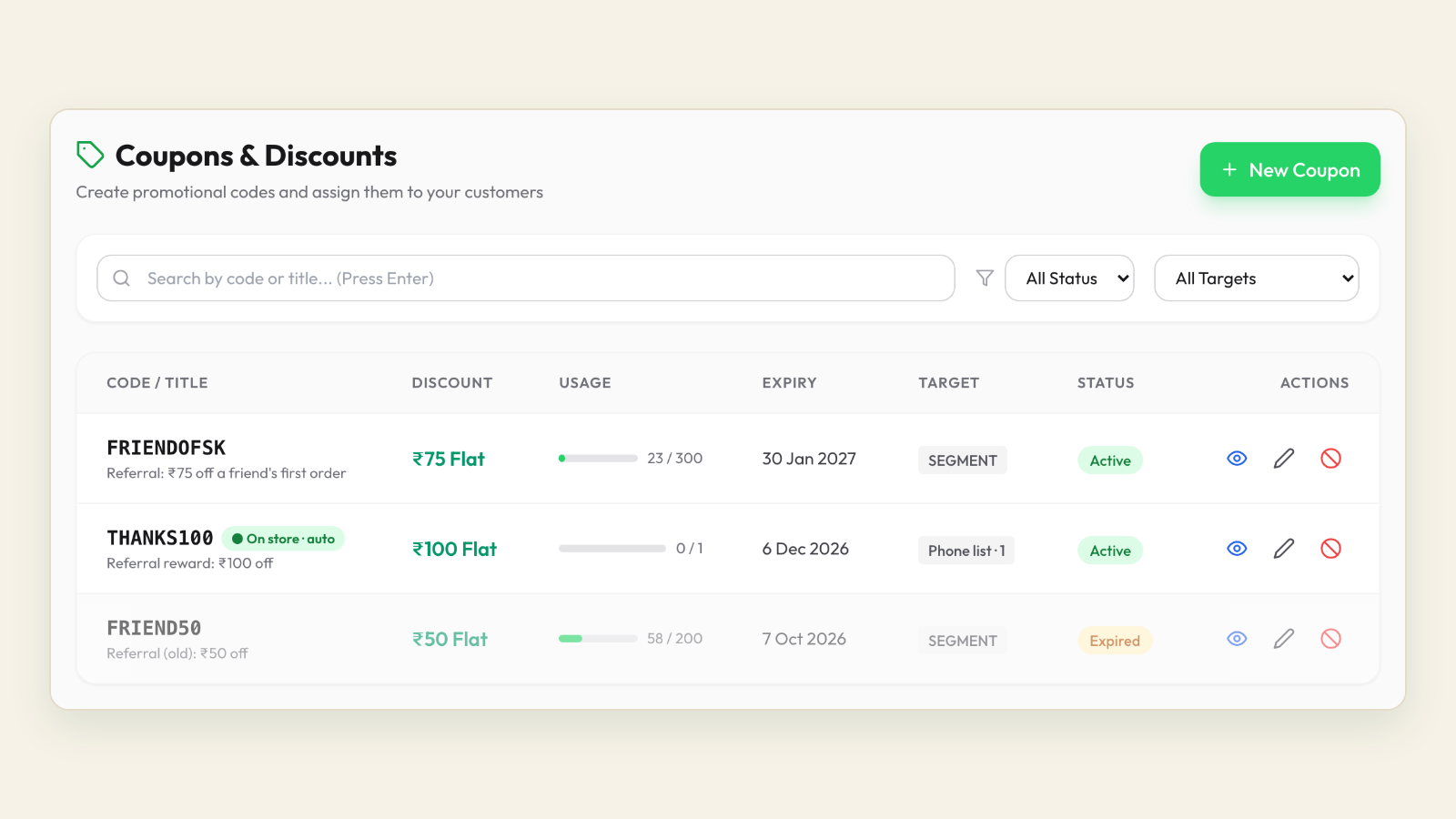
On Tezzu, a referral program is two coupons and a message. Create the friend's code with a minimum order, an end date and a first-order-only rule, and the referrer's reward code alongside it. Keep the friend's code as a typed code rather than auto-apply, because the code is how you know who sent them. Orders arrive on your own WhatsApp number or store page, so the referred customer is captured on their first order and enters the second-order routine like anyone else. The ask goes out as a campaign to the regulars you choose.
Checklist: referrals
- Reward structure chosen and written as one line.
- Friend's code limited to first orders, with a minimum order.
- Referrer's reward sent after delivery, with a 30-day expiry and a monthly cap.
- Personal codes created for your ten most active regulars.
- The ask added to the 5-star reply routine and the third-order progress message.
Your 90-day plan
The plan runs in fortnights, with one sitting every Monday and a longer review on the first of each month. It assumes you already take some orders on your own WhatsApp number or store page. If you are starting from zero, add two weeks at the front and follow the setup playbook first.
| Days | Focus | Actions | Done when |
|---|---|---|---|
| 1 to 14 | Baseline and capture | Five numbers calculated; bag cards in every order, app orders included; opt-in question live; test order passes the first-experience checks; rating requests on; low-rating owner named for each shift | Baseline written down; every order gets a card and a rating request |
| 15 to 28 | The second order | First two Monday batches sent; split test running; weekly cause tally started; 5-star raters getting the Google review link | Two batches sent; first cause fixed in the kitchen |
| 29 to 42 | Segments and the first win-back | First monthly refresh; six segments assigned; win-back message 1 to the lapsed segment; regulars hear about a new dish with no discount | Lapsed list messaged; no discount sent to regulars |
| 43 to 56 | Loyalty | Format and threshold chosen; rule on the bag card; progress and reward messages approved; win-back message 2 on day 14 of the sequence | First progress messages sent |
| 57 to 70 | Referrals | Shared and reward codes created; personal codes for ten regulars; ask sent to 5-star raters and third-order customers; second monthly refresh; split test read and coupon decision made | First referred orders delivered |
| 71 to 84 | Close the win-back | Win-back message 3 on day 42; non-responders removed; first loyalty rewards redeemed | Marketing list cleaned |
| 85 to 90 | Review and reset | Third monthly refresh; compare cohorts before and after the second-order routine; 60-day check on win-back returns; keep what moved, drop what did not | Next 90-day targets written |
The scorecard
Fill this in on the first of each month. The targets are directional, because your starting point is your own.
| Metric | Where it comes from | Day 30 | Day 60 | Day 90 |
|---|---|---|---|---|
| Second order rate, by cohort | Customer insights and the orders list | Baseline measured | Routine cohort ahead of the one before | Several points above baseline |
| Low ratings answered within the hour | Your shift log | Every one | Every one | Every one |
| Top cause of low ratings | The weekly tally | Named | Fixed and falling | Next cause named |
| Lapsed regulars | Monthly refresh | Counted; message 1 sent | Falling | Below baseline |
| Win-back and referral orders | Orders list, filtered by code | Message 1 orders counted | Message 2 orders counted | Referred orders in; 60-day check done |
| Repeat order share and orders per active customer | Monthly refresh | Baseline | Rising | Above baseline |
The Monday sitting in 30 minutes
- Send the second-order nudge to the new batch and the reminder to last week's.
- Run the loyalty count: progress messages, reward codes, reminders.
- Count last week's low-rating causes and choose one fix.
- Check that 5-star raters got the review link and referrers got their rewards.
- Send any win-back message that falls due, then write down one change for next week.
When a number will not move
- Second order rate flat after two cohorts: the problem is usually the first order. Read the ratings from first-time customers only.
- Few ratings coming back: staff are probably marking orders delivered late, or at dispatch.
- Loyalty rewards redeemed but frequency flat: raise the threshold or change the reward.
- STOP replies or blocks rising: check the one-message-a-week cap and drop anyone past your lapsed window who finished the sequence.
Frequently asked questions
What is a good customer retention rate for a restaurant?
There is no single benchmark that fits a tiffin service and a weekend family restaurant alike, and published figures vary widely by format. The useful approach is to measure your own 30-day second order rate and 90-day retention by monthly cohort, then improve them quarter on quarter. A few points of improvement in the second order rate changes the economics of every customer you acquire, as the worked numbers in Chapter 1 show.
How do restaurants get repeat customers without an app?
Through the channels customers already use. Orders on your own WhatsApp number capture the customer's number, a rating request after each order catches problems early, a coupon on WhatsApp delivers a loyalty reward, and a weekly message reaches people when they decide what to eat. A card in every bag, including delivery app orders, moves customers onto that channel. Nobody has to download anything.
How often should a restaurant message its customers on WhatsApp?
No more than one marketing message per customer per week, across every segment and campaign. Order confirmations, status updates and rating requests do not count against that cap, because the customer asked for them. Send marketing messages between 11 am and 7 pm, before the meal you want them to order, and honour every STOP the same day. Messaging more often than weekly is the fastest way to get blocked.
Should I give discounts to bring customers back?
Small, targeted and with a deadline, yes. A ₹50 code for a customer's second order or for a lapsed regular costs little and often pays back many times over. The expensive mistake is a blanket discount to the whole list, which mostly reaches regulars who would have paid full price. Give each offer its own code, send it only to the segment that needs it, and check whether it changed behaviour.
Can I improve retention if most of my orders come from delivery apps?
Yes, but capture comes first, because you cannot see or message app customers. Put a card in every app order with a QR code to your WhatsApp number and a reason to order direct, such as free delivery above a threshold. As those customers place direct orders, they enter your second-order routine, loyalty program and segments. Retention becomes measurable only on the orders you own.