A restaurant referral program is the cheapest acquisition channel most food businesses never set up. A regular tells a friend, the friend orders with a code, and both get something small. The new customer arrives with trust already built, which makes their second order easier to win, and the whole thing costs you a coupon instead of a commission.
This guide covers why referrals work so well for food, four reward structures with their trade-offs, how to set the program up on WhatsApp without an app, message templates for each step, and the rules that stop the program being gamed. It assumes you take at least some orders on a channel where you can see who ordered.
Why referrals work for food businesses
Food is already the most recommended category of purchase in any WhatsApp group. People send photos of their dinner, ask where the good biryani is, and forward menus. A referral program does not create that behaviour; it gives it a code and a reason to happen this week instead of eventually.
Referred customers are also different from customers who arrive through an app. They were told about you by someone they trust, so they order with less hesitation, complain less about small things, and are more likely to place a second order. For a single restaurant competing against hundreds of listings, that trust is worth more than reach.
And the economics are kind. A ₹50 reward on each side of a referral costs ₹100 to win a new customer who already likes you, which is less than the commission on a single aggregator order of ₹350. The restaurant customer retention guide puts this alongside the other ways of lowering what a customer costs to win.
Choosing the reward: four structures compared
The reward decides whether people bother. Too small and nobody shares; too large and you attract people who only order with a code. The four structures below cover most restaurant referral programs.
| Structure | How it works | Best for | Watch out for |
|---|---|---|---|
| Two-sided discount | Friend gets ₹50 off their first order; referrer gets ₹50 off their next | Delivery kitchens and cafes with frequent orders | Set a minimum order so the discount is not larger than the margin |
| Free item for the referrer | Friend orders; referrer gets a free dessert or starter on their next order | Dine-in and family restaurants | Pick an item with low food cost and high menu price |
| Milestone reward | Refer three friends who order, get a ₹300 voucher | Tiffin services and subscription formats | Needs tracking per referrer; tell people their progress |
| Friend-only offer | Only the friend gets a discount; the referrer gets a thank you | Restaurants with thin margins | Fewer shares, because the referrer has no stake |
For most single-outlet restaurants, the two-sided discount with a minimum order is the right starting point. It is easy to explain in one line, both people have a reason to act, and it runs on two coupon codes. The sizing maths for the discount itself is in restaurant coupon codes: strategy, examples and fraud prevention.
Setting up a restaurant referral program step by step
Step 1: write the one-line rule
"Share this code with a friend. They get ₹50 off their first order above ₹300, and you get ₹50 off your next." If the rule needs a second sentence, simplify it. Add an expiry for the referrer's reward, usually 30 days, so it gets used.
Step 2: decide how the code works
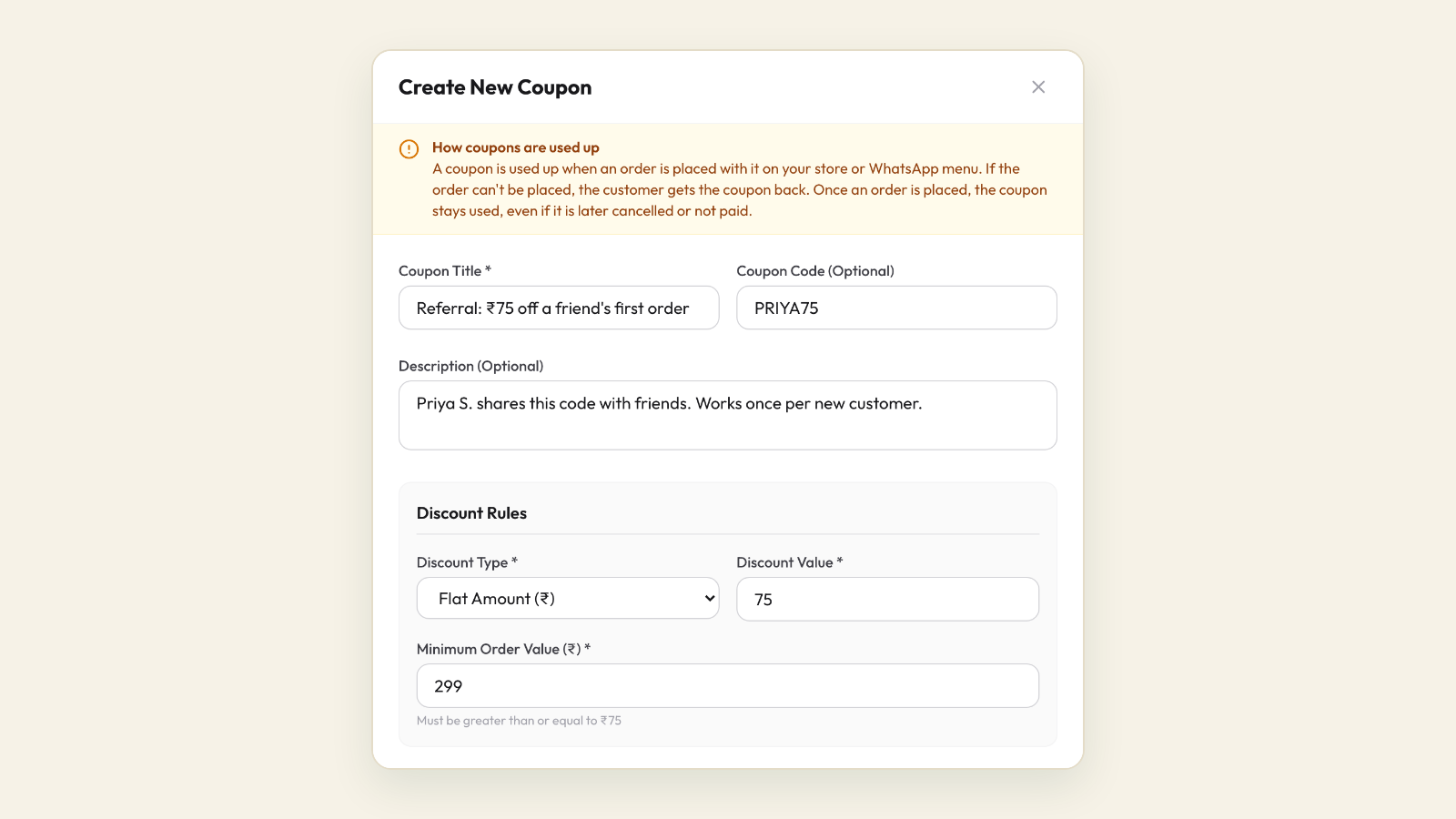
Two options. A single shared code such as FRIEND50 that any new customer can use, with the referrer named in the order chat; simple, but harder to attribute. Or a code per referrer, such as PRIYA50, created for regulars who ask; more work, but every use is attributed and the referrer feels ownership. Most restaurants start with the shared code and create personal codes for their ten most active regulars.
Step 3: make the friend's order direct
The code works only on orders placed on your WhatsApp number or store page. This is deliberate: the referred customer arrives on the channel where you capture their number, pay no commission, and can message them later. A referral that lands on an aggregator costs you commission on top of the discount.
Step 4: send the referrer their reward
When the friend's order is delivered, message the referrer the same evening with their reward code. Speed matters here; a reward that arrives a week later feels like an afterthought. If your ordering system can auto-apply a coupon, the referrer's reward can simply apply itself at their next checkout.
Step 5: ask at the right moment
The best time to ask for a referral is right after a good experience: a five-star rating, a thank-you message, a third order. Do not blast the referral ask to your whole list on a Tuesday afternoon. Send it to people who have just told you they are happy.
Step 6: review monthly
Count codes used, new customers acquired, and how many of them placed a second order. If the referred customers do not come back, the reward is attracting discount hunters, and you should raise the minimum order or switch to a free-item reward.
Referral message templates
Send these from your business number. Replace the bracketed parts and keep each message under five lines.
The ask, after a high rating or a thank you:
Thanks for the kind words, [name]. If you know someone who would like our [dish], share this code: [CODE]. They get ₹50 off their first order above ₹300, and you get ₹50 off your next. Order link for them: [store link]
The ask, to a regular after their third order:
[Name], you have ordered from us three times now, which makes you a regular. We would rather reward you than pay for ads: share [CODE] with a friend, and you both get ₹50 off. Valid till [date].
The friend's welcome, on their first order:
Welcome, and thank [referrer name] for us. Your ₹50 off is applied. If tonight's order is good, save this number; everything on the menu is here: [store link]
The referrer's reward, the same evening:
[Name], your friend [friend name] just ordered with your code. Your ₹50 off is ready: use [REWARD CODE] on any order above ₹300 before [date]. Thank you for sending them our way.
The milestone message, for the three-referral structure:
Two friends have ordered with your code, [name]. One more and a ₹300 voucher is yours. Code to share: [CODE]
Each of these works as a normal message to one person. For the ask to a group of happy customers, the same text goes out as a campaign; sending your first WhatsApp campaign from Tezzu shows the mechanics.
Keeping it honest: rules and fraud
Referral programs get gamed in predictable ways, and a few rules prevent most of it.
- First order only, new number only. The friend's discount applies to a phone number that has never ordered before. A customer referring their own second number is the most common abuse, and this rule catches it.
- Minimum order. ₹50 off a ₹120 order is a loss. A ₹300 minimum keeps the discount within margin.
- Reward after delivery, not after order. The referrer's code goes out when the friend's order is delivered and paid, so a cancelled order does not earn a reward.
- Cap per referrer per month. Five referrals a month is generous for a genuine customer and a brake on anyone running a code through a college hostel.
- Expiry on the reward. Thirty days. Unused rewards pile up as a liability and lose their effect.
- Same rules for everyone. Publish the rules in the message or on the store page. Arguing about exceptions at the counter costs more than the discount.
Because referral orders come through WhatsApp, each use of a code is tied to a real phone number, which makes abuse far easier to spot than on an anonymous web form. A referral program also pairs naturally with a loyalty reward, so that a referred friend who orders a third time starts earning too; the formats are in restaurant loyalty program on WhatsApp.
What this looks like on Tezzu
On Tezzu, a referral program is a pair of coupon codes and a message. You create the friend's code and the referrer's reward code as coupons in the dashboard; coupons can be set to auto-apply at checkout, so the friend sees the discount come off without typing anything. Orders come in on your own WhatsApp number and your free store page, so the referred customer's number is captured on their first order and is in your customer insights from then on.
The ask goes out as a WhatsApp campaign to the customers who rated their last order highly, paid from a prepaid wallet, and the referrer's reward is a message with their code the evening the friend's order is delivered. There is no commission on referral orders or any other: a flat ₹10 per order, on plans from ₹999 a month, each with a 7-day free trial. More ways to keep the referred customers coming back are in how to get repeat orders.
Set up the two codes and start asking
Create your referral coupons, take the friend's first order on your own number, and send the ask to happy customers from one dashboard.
Start your free 7-day trialFrequently asked questions
What is a good referral reward for a restaurant?
For most delivery and cafe formats, ₹50 off for both the friend and the referrer, with a ₹300 minimum order, is large enough to share and small enough to stay within margin. Dine-in restaurants often do better with a free dessert or starter for the referrer, which has a low food cost and a high perceived value. Set an expiry so rewards get used.
How do you run a refer-a-friend program without an app?
With two coupon codes and WhatsApp. The friend uses a code on their first direct order; you message the referrer a reward code when that order is delivered. Orders on your own WhatsApp number capture the friend's number, which is how you tell a new customer from an existing one. No downloads, no points engine, no card.
How do you stop people abusing a referral program?
Apply the friend's discount only to phone numbers that have never ordered, set a minimum order, release the referrer's reward only after the friend's order is delivered and paid, cap referrals per person per month, and put an expiry on rewards. Because WhatsApp orders carry a real number, repeat abuse is easy to spot and block.
When should a restaurant ask customers for referrals?
Right after a good experience: a five-star rating, a thank-you message, or a third order. A referral ask sent to someone who has just told you they are happy gets shared; the same ask broadcast to the whole list on a quiet afternoon mostly gets ignored. Once a quarter, a general reminder to regulars is reasonable.