WhatsApp food ordering Singapore hawker stalls, home bakers and small restaurants already run informally is the most common ordering channel in the country after the delivery apps, and the same is true across the Causeway in Johor Bahru, Kuala Lumpur and Penang. A customer messages "2 nasi lemak, 1 teh peng, collect 12.30", the stall replies "ok", and the order is written on a sticky note. It works until lunch rush, when the phone is in someone's apron pocket and three messages go unanswered.
This guide covers why WhatsApp fits how Singapore and Malaysia order food, what the delivery apps cost against a direct channel, how to set up a proper ordering flow with a menu and payment, the payment and tax details for each country, delivery and pickup, and the marketing rules under both countries' PDPA.
Why WhatsApp fits how Singapore and Malaysia order food
WhatsApp is the default messaging app in both countries, across English, Malay, Chinese and Tamil-speaking communities, for families, condo groups, offices and school parents. A business number saved from a stall sign or an Instagram bio is as normal as a phone number was a generation ago.
The food businesses that gain most from a proper WhatsApp ordering flow are the ones that already take orders by message:
- Hawker and coffee shop stalls taking lunch pre-orders from nearby offices and collection orders from regulars.
- Home-based food businesses selling kueh, cakes, Peranakan dishes, rendang by the tub, biryani on Fridays or Deepavali and Hari Raya cookies by pre-order.
- Small restaurants and cafes with a base of regulars who reorder weekly and a catering line for office lunches.
- Tingkat and daily meal services delivering to the same addresses every day on monthly plans.
Then there is the cost of the apps. Delivery app commission in Singapore and Malaysia is commonly reported in the high twenties to around 30 percent of order value for platform-delivered orders, with lower rates for self-pickup and self-delivery, plus the promotions and ads merchants fund to stay visible. For a stall selling S$6 plates or a Malaysian cafe selling RM15 meals, that percentage is most of the margin. The same structure, and the same answer, applies in every market we have looked at, from food delivery app commission fees in the US to the Gulf.
What the delivery apps cost against a direct channel
Figures below are ranges commonly reported by merchants; the platforms negotiate per business and publish partial information. Check your own agreement and their current merchant pages.
| Channel | Pricing model | Commonly reported cost | Who holds the customer |
|---|---|---|---|
| Delivery app, the app delivers | Commission on order value, plus GST or SST on the commission | High twenties to around 30 percent | The app |
| Delivery app, customer self-pickup | Lower commission since no rider is involved | Noticeably lower than the delivery rate | The app |
| Delivery app, you deliver | Commission on order value at a self-delivery rate, with your own rider | Between the pickup and app-delivered rates | The app |
| Own WhatsApp and store page channel | Monthly subscription plus a flat per-order fee; payment processing on top | Low cost per order that falls with volume | You |
| Informal WhatsApp with staff replying | Free | Staff time, missed messages, no record, manual payment checks | You, on one phone |
On a S$25 order, a 30 percent commission is S$7.50. A direct channel with a flat per-order fee and PayNow or card processing costs well under S$1. On 400 repeat orders a month, the gap is around S$2,500. Most food businesses in both countries land on the same arrangement: the apps for being discovered, a WhatsApp channel for the regulars.
Setting up a WhatsApp ordering flow
The difference between informal WhatsApp ordering and a working system is the WhatsApp Business API connected to an ordering platform. The free WhatsApp Business app gives you one phone, a catalogue and quick replies; the API gives you a bot that shows the menu, takes the order, collects the address or pickup time and payment, and confirms, with any number of staff watching a shared dashboard. The trade-offs are laid out in WhatsApp Business vs WhatsApp Business API.
The number
Use a Singapore or Malaysian mobile number registered to the business and keep it permanently. The API connection goes through Meta's embedded signup with your business details; the number stays yours.
The menu
Build it once with categories, variants (regular or large, less spicy, no chilli) and add-ons. Prices should be shown the way customers expect: GST-inclusive in Singapore, and with any service tax clearly stated in Malaysia. If you serve lunch crowds, use menu scheduling so lunch sets show only at lunch and the Friday-only biryani appears only on Fridays.
Languages
English item names work for most customers in both countries. Add Malay or Chinese in descriptions where your customers expect it. Keep free-text replies from staff in whatever language the customer used.
Licences
In Singapore, food businesses need the relevant SFA licence, and small-scale home-based food businesses operate under conditions set by HDB or URA with SFA food safety rules. In Malaysia, register the business with SSM and obtain the local council's food premises or home-based business licence; halal certification is optional but matters to many customers. Confirm the current rules with the authority before advertising a number publicly.
Payments: PayNow, DuitNow, cards and tax
Singapore
PayNow to your business UEN is the payment method customers expect for small orders, and cards or digital wallets for larger ones. A payment step inside the ordering flow should offer both, with the order marked paid automatically rather than after a screenshot. GST applies if you are registered; show GST-inclusive prices and issue a tax invoice on request. The registration threshold and the current GST rate are on IRAS's website; check them rather than relying on what a neighbouring stall does.
Malaysia
DuitNow QR, digital wallets, FPX bank transfer and cards cover almost every customer. Cash on delivery and cash on collection are still common outside the Klang Valley, so keep them as options and mark payment collected when the order is handed over. Service tax under SST applies to food and beverage businesses above a revenue threshold; confirm with your accountant whether you are in scope and show prices accordingly.
In both countries, advance payment for pre-orders is normal and expected: a Hari Raya cookie order or a Deepavali sweets box is paid when ordered, which stops you baking for customers who do not turn up.
Delivery, pickup and distance
Singapore is small enough that "islandwide delivery" is tempting and expensive. A stall in Toa Payoh delivering to Jurong at lunch is a 40-minute ride each way. Set delivery zones with charges by distance: cheap or free within a couple of kilometres, a higher charge out to five or six, and pre-order only beyond that. On-demand courier services deliver single orders you took yourself for a per-trip fee, which is usually cheaper than commission on anything above a small ticket.
Malaysia's cities sprawl, so zones matter even more. A Petaling Jaya cafe should serve PJ and nearby areas well before promising Cheras. Riders on motorbikes, employed or on-demand, are the norm; set zones so that no rider is sent on a 20-kilometre run for an RM18 order.
Pickup is the underused channel in both countries. Office workers will collect from a stall or cafe if there is a slot system and the order is ready when they arrive. Collection slots in 15-minute windows during lunch, with a cut-off, let the kitchen batch orders. Whatever the mix, send a status message when the order is accepted, when it is ready or on its way, and when it is delivered.
Marketing rules: PDPA in both countries
Both Singapore and Malaysia have a Personal Data Protection Act, and both expect consent before marketing messages are sent to a phone number. Singapore's Do Not Call provisions also apply to marketing messages sent to local numbers, so a customer's order does not by itself permit promotions; ask clearly, record the answer and honour opt-outs immediately. WhatsApp's own rules sit on top: numbers that get reported for unwanted messages are restricted.
What works, sent one or two times a week at most:
- Festival pre-orders. Chinese New Year goodies, Hari Raya cookies and rendang, Deepavali sweets, Christmas log cakes, with a cut-off date and advance payment.
- Office lunch sets. A Monday message with the week's sets to office customers only.
- New dish or weekend special. One message with a photo and a direct link.
- Win-back. A single message to anyone quiet for six weeks.
The same approach applies in other markets with strong WhatsApp use, which we cover for the Gulf in WhatsApp ordering for restaurants in Dubai and the UAE and for the UK in WhatsApp ordering for UK takeaways.
How Tezzu handles WhatsApp food ordering
Tezzu turns your own WhatsApp number into an ordering channel through Meta's embedded signup, so the number on your stall sign or Instagram bio keeps working. A bot shows your menu with categories, variants and add-ons, takes delivery or pickup, checks the address against your zones, collects the payment choice and confirms. Every order lands on a live dashboard and on the staff app, which gives new-order alerts so a stall or kitchen never misses a message during a rush, and prints as a KOT if you use a thermal printer.
You also get a free store page at tezzu.in/store/your-name with a web menu, which you can put on your own domain. Delivery zones with distance-based charges and free-delivery thresholds, self-pickup points with collection times, scheduled orders and pre-orders, menu scheduling by weekday and time, bundles and combos, coupons, reviews after each order and WhatsApp campaigns from a prepaid wallet are included. Setup takes about 30 minutes; the steps are in how to set up WhatsApp ordering with Tezzu.
Tezzu's published plans are in rupees for India and in US dollars for US merchants, with a flat per-order fee and no commission. If you run a food business in Singapore or Malaysia, book a demo to confirm currency, PayNow or DuitNow options and tax invoicing for your setup before starting a trial.
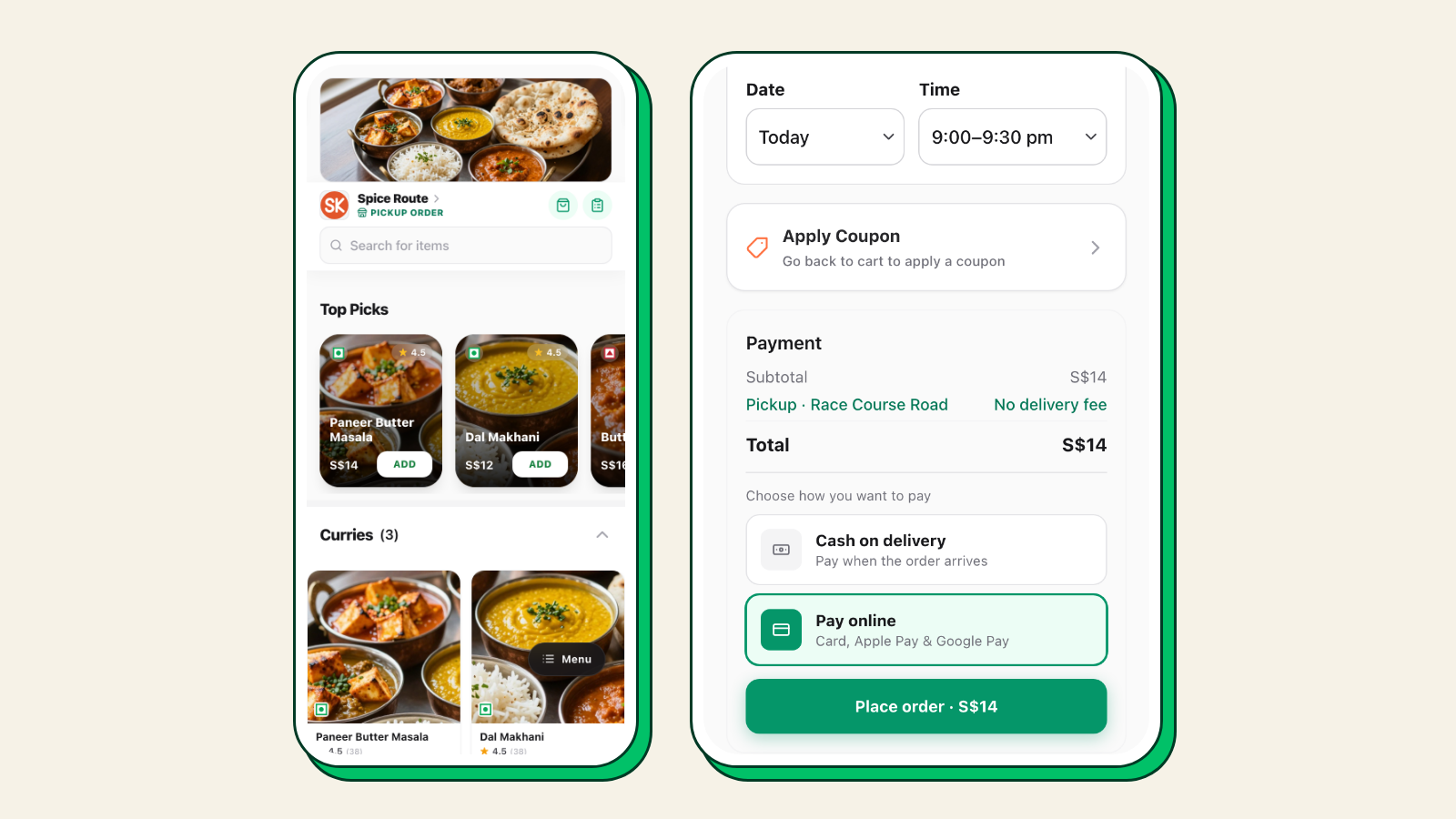
See the flow with your own menu
Bring your menu and your delivery areas. We will walk through the ordering bot, pickup slots, zones and payments, and confirm what is available for Singapore or Malaysia.
Book a demoFrequently asked questions
Can a hawker stall or home-based food business use WhatsApp ordering in Singapore?
Yes. The WhatsApp Business API works with Singapore numbers, and the connection is made through Meta's embedded signup with your business details. You need the appropriate SFA licence, and home-based food businesses must meet HDB or URA conditions. Once connected, a bot takes orders, pickup slots and PayNow or card payments automatically.
How do customers pay for WhatsApp food orders in Singapore and Malaysia?
In Singapore, PayNow to the business UEN and cards or digital wallets through a payment step in the flow. In Malaysia, DuitNow QR, digital wallets, FPX and cards, with cash on collection still common. The order should be marked paid automatically rather than after a screenshot. Advance payment is standard for festival pre-orders.
Is WhatsApp ordering cheaper than the delivery apps?
For repeat customers, usually by a wide margin. Delivery app commission in both countries is commonly reported in the high twenties to around 30 percent of order value for delivered orders, while a direct channel costs a subscription plus a small per-order fee and payment processing. Most businesses keep the apps for new customers and move regulars to WhatsApp.
Can I send promotions on WhatsApp under PDPA?
Yes, to customers who have given clear consent, with an easy opt-out that you honour immediately. In Singapore the Do Not Call provisions also apply to marketing messages sent to local numbers, so an order alone does not permit promotions. Keep frequency to one or two messages a week and record each customer's consent.