WhatsApp ordering Dubai restaurants already run informally looks like this: a customer messages "2 chicken biryani, 1 raita, Al Barsha, cash", the counter replies "ok 40 mins", and someone writes it on a pad. It works until the Friday rush, when three staff answer the same number from one phone, two orders get missed, and a regular who sent a voice note never hears back. The question for a UAE restaurant is how to keep the channel customers clearly prefer while making it reliable enough to run a business on.
This guide covers why WhatsApp fits the UAE market so well, the difference between the WhatsApp Business app and the API, how to set up menus, payments, VAT and delivery zones for Dubai, Abu Dhabi and Sharjah, and the marketing rules to respect.
Why WhatsApp fits how the UAE orders food
The UAE's population is mostly expatriate, with large South Asian, Arab, Filipino and Western communities, and WhatsApp is the shared messaging layer across all of them. Voice calls over WhatsApp have been restricted in the country for years, but messaging, which is all an ordering flow needs, works normally. Most residents already have the restaurant's number saved from a flyer or a building group.
Ordering habits also suit it. Office lunches in Business Bay, DIFC and Media City are repeat orders from the same desks every week. Villa communities in Arabian Ranches or Mirdif order from the same five restaurants on rotation. Ramadan iftar boxes, Friday family orders and office catering are large pre-planned orders that aggregator apps handle badly.
Then there is the cost of the apps. Commission on the delivery apps in the UAE is commonly reported in the 20 to 30 percent range of order value, with VAT on the commission, plus the promotions and ads restaurants fund to stay visible. Our breakdown of food delivery app commission in the UAE goes through the full bill. The pattern is the same one US restaurants face with the large marketplaces, which we cover in US food delivery app commission fees: the app is good for being found and expensive for being reordered from.
WhatsApp Business app vs WhatsApp Business API
Most Dubai restaurants start on the free WhatsApp Business app and outgrow it. The API is what turns the number into an ordering system.
| Question | WhatsApp Business app | WhatsApp Business API through an ordering platform |
|---|---|---|
| Who can answer | One phone, with limited linked devices | Any number of staff on a shared dashboard and staff app |
| How customers order | They type free text; staff read and reply | A bot shows the menu, takes items, address, payment and confirms automatically |
| Payment | You send a payment link by hand or take cash | Payment collected in the flow; cash on delivery as an option |
| Order status | Staff type "on the way" when they remember | Automatic updates as the kitchen moves the order through statuses |
| Promotions | Broadcast lists capped at a few hundred saved contacts | Campaigns to your whole opted-in list, paid per message |
| Cost | Free | Platform subscription plus per-order or per-message charges |
The full comparison, including what Meta charges for API conversations, is in WhatsApp Business vs WhatsApp Business API. The short version for a UAE restaurant: if more than one person answers orders, or you take more than around 30 orders a day on WhatsApp, the app is already costing you missed orders.
Setting up WhatsApp ordering for a UAE restaurant
The number
Use a UAE mobile number registered to the business, and keep it. Customers save restaurant numbers for years, and changing one loses orders for months. The API connection is made through Meta's embedded signup, which verifies your business and attaches the number without moving it to a new SIM.
The menu
Build the menu once with categories, variants (half or full portion, spice level) and add-ons. Prices should be shown inclusive of VAT, which is how UAE customers expect to see them. If you serve office workers, create lunch combos and keep them visible only at lunch hours using menu scheduling, so dinner customers are not shown a dead combo.
Languages
English covers most of the UAE's ordering population. Arabic matters for Emirati and Arab expatriate customers, and Hindi or Urdu helps with a large share of workers and families. At minimum, keep item names in English with short descriptions, and make sure your staff replies to free-text questions are in the customer's language.
Licences
You need your trade licence and food permit from the relevant authority (Dubai Municipality or Abu Dhabi's equivalent) in place regardless of channel. Home-based food businesses have their own permit routes, which differ by emirate; check before you advertise a WhatsApp number publicly.
Payments in the UAE: cards, digital wallets, cash and VAT
The UAE is a card-first market. Most customers expect to pay by card or a digital wallet inside the ordering flow, and a link that opens a card page is normal. Cash on delivery still exists, especially in Sharjah and older Dubai neighbourhoods, and refusing it costs orders. Offer both and watch the mix.
Three things to get right:
- Gateway. Several gateways operate in the UAE; check which ones your ordering platform supports and what they charge per transaction, usually a small percentage plus a fixed fee. Settlement timing varies by gateway and bank.
- VAT. Restaurant food carries 5 percent VAT. Show VAT-inclusive prices and issue a tax invoice with your TRN on request. Your ordering platform should produce a bill that satisfies this.
- Cash control. For cash-on-delivery orders, mark payment collected when the rider returns, so your dashboard revenue matches the cash box at closing.
Advance payment for large orders is standard in Dubai: a party order for AED 800 should be paid, or at least part-paid, at the time of ordering. Pre-orders with payment in the flow make this automatic.
Delivery zones, riders and pickup across Dubai
Dubai's geography punishes vague delivery rules. A restaurant in Karama that accepts an order from Jumeirah Village Circle at 8 pm on a Thursday will deliver cold food 50 minutes later and get a one-star review. Set zones with charges by distance: free or cheap within three kilometres, a higher charge out to eight, and nothing beyond that unless it is a pre-order.
Rider options in the UAE:
- In-house riders on motorbikes. Standard for most restaurants doing more than a few dozen deliveries a day. Cost is a fixed monthly salary, visa and bike, so it gets cheaper per order with volume.
- Third-party rider fleets. Several companies supply riders per delivery or per shift. Useful for peaks and for Ramadan evenings.
- Pickup. Underused in Dubai outside of coffee. Office customers will collect from a counter if there is a slot system and the order is ready on time.
Whatever the mix, the customer should get a status message when the order is accepted, when it leaves, and when it is delivered. That one habit removes most "where is my order" messages.
Marketing on WhatsApp in the UAE
WhatsApp campaigns work in the UAE for the same reason the channel works for ordering: people read their messages. The rules matter, though. Message only customers who have ordered from you or opted in, keep frequency to one or two messages a week, and make it easy to reply "stop". The UAE has data protection law and anti-spam provisions, and WhatsApp itself blocks numbers that get reported, so a bad campaign can cost you the number.
What works in practice:
- Ramadan. Iftar box pre-orders opened two weeks before the month, with set menus and a cut-off time each day. Our Ramadan iftar box playbook has the full calendar.
- Office lunch. A Sunday message with the week's lunch combos to office customers only.
- Weekend family orders. A Thursday afternoon message with a family platter.
- Win-back. One message to anyone quiet for 45 days, with a small offer and a direct link.
How Tezzu handles WhatsApp ordering for UAE restaurants
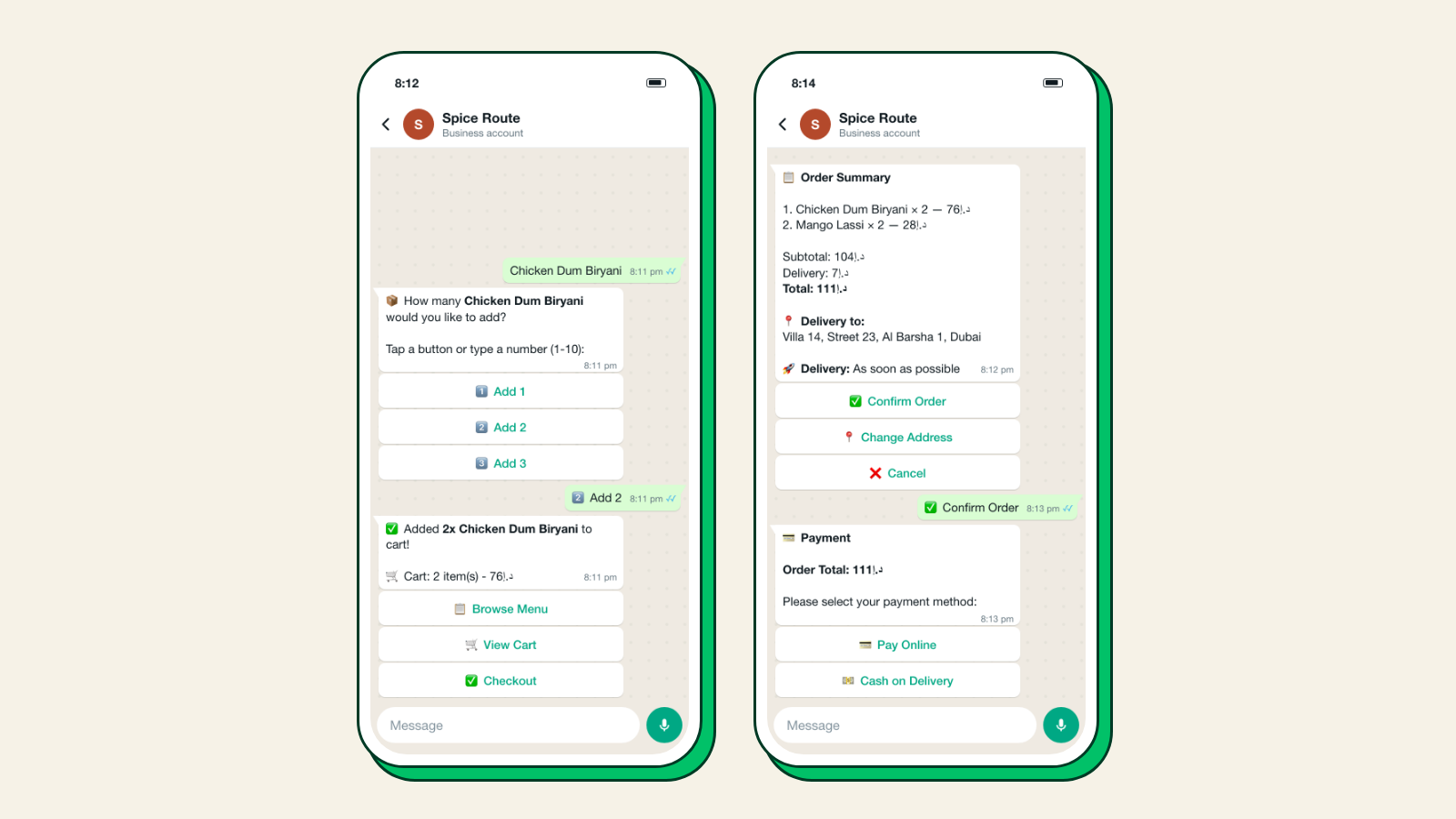
Tezzu turns your own WhatsApp number into an ordering channel through Meta's embedded signup, so you keep the number customers have saved. A bot shows your menu with categories, variants and add-ons, collects the address and payment choice, and confirms the order. Every order lands in a live dashboard and on the staff app, which gives new-order alerts so the counter never misses a message during a rush.
Alongside WhatsApp you get a free store page at tezzu.in/store/your-name with a web menu, which you can put on your own domain. Delivery zones with distance-based charges, self-pickup points with collection times, scheduled orders and pre-orders, cash on delivery, bundles and combos, menu scheduling by weekday and time, and WhatsApp campaigns from a prepaid wallet are all included. Reviews are collected after delivery and shown on your store. The interface is available in English and Hindi.
Tezzu's published plans are in rupees for India and in US dollars for US merchants, with a flat per-order fee and no commission. If you run a restaurant in the UAE, book a demo to confirm currency, payment gateway options and VAT invoicing for your setup before you start a trial. The setup itself takes about 30 minutes, as shown in how to set up WhatsApp ordering with Tezzu.
See the WhatsApp flow with your menu
Bring your menu and your delivery areas. We will walk through the ordering bot, zones, payments and what is available for a UAE restaurant.
Book a demoFrequently asked questions
Can restaurants in Dubai use WhatsApp Business API?
Yes. The WhatsApp Business API works with UAE numbers, and the connection is made through Meta's embedded signup with a verified business. Messaging works normally in the UAE; only WhatsApp voice and video calls have been restricted, which does not affect an ordering flow. You will need your trade licence and business details for verification.
How do customers pay for WhatsApp orders in the UAE?
Most pay by card or a digital wallet through a payment step inside the ordering flow, and many restaurants also offer cash on delivery. Prices should be shown inclusive of 5 percent VAT, and your system should issue a tax invoice with your TRN when asked. Advance payment is standard for large or party orders.
Is WhatsApp ordering cheaper than the delivery apps for a Dubai restaurant?
For repeat customers, usually yes by a wide margin. Aggregator commission is commonly reported at 20 to 30 percent of the order value plus VAT and funded promotions, while a direct channel costs a subscription plus a small per-order fee and payment processing. Most restaurants keep the apps for discovery and move regulars to WhatsApp.
Can I send promotions to customers on WhatsApp in the UAE?
Yes, to customers who have ordered from you or opted in, using approved message templates through the API. Keep frequency low, make opting out easy, and follow UAE data protection and anti-spam rules. Numbers that get reported for unwanted messages can be restricted by WhatsApp, so treat your list carefully.