Delivery apps vs direct ordering in the USA is the comparison that matters for a small restaurant, and most owners start with a different one: which delivery app to sign with. Every large marketplace charges a percentage of each order for putting you in front of customers who do not know you, so choosing between them is choosing between commission rates. The real decision is how much of your business should run through any marketplace, and what you use for the orders that come from people who already know your name. That is where direct ordering, the third column in this comparison, changes the arithmetic.
This post compares the two common delivery app fee models on fee structure, delivery, subscription programmes, customer data and who each suits, then sets direct ordering beside them on the same $30 order. Fee figures are as listed on the apps' websites at the time of writing; check their current pricing pages before signing anything.
The short answer
If you need new customers in a market where you are unknown, list on two apps and compare net revenue per order after three months; which one wins depends on your zip code more than on their rate cards. If you have a base of regulars, no marketplace should carry their repeat orders, because you pay commission on customers you already own. A direct ordering channel with a flat per-order fee handles those orders at a fraction of the cost and gives you the customer's number for next time.
Most small restaurants end up with a mix: one or two delivery apps for discovery, a direct channel for repeat orders, and a steady effort to move customers from the first to the second.
How delivery apps charge restaurants
The split-fee model
One of the large marketplaces splits its charge into pieces, which makes the total easy to underestimate. There is a marketing commission on each order, which rises across tiered plans in exchange for more visibility and inclusion in the app's customer subscription programme. If the app's drivers deliver, a separate delivery commission is added. A payment processing fee per order sits on top of both. Restaurants that deliver with their own staff avoid the delivery commission and pay only marketing plus processing.
The same app also offers a commission-free ordering website for your own domain, where you pay processing fees per order and a delivery charge if its drivers are used. Its customer subscription has been bundled with a large retail membership programme, which pushes subscriber volume toward restaurants on plans that include it.
The single-commission model
The other large marketplaces use three partnership plans with a single delivery commission percentage each, listed in the range of 15 to 30 percent at the time of writing, and a single-digit commission on pickup orders. The middle and top tiers include the app's customer subscription and a wider delivery radius. There is no separate processing line on marketplace orders; it is inside the commission.
These apps also offer a commission-free storefront page of their own, with processing fees per order and a flat delivery fee if their drivers deliver, and a white-label delivery service that supplies drivers for orders you took yourself at a flat fee per delivery. The full structure is in our guide to US food delivery app commission fees for restaurants.
The two largest single-commission apps mirror each other's tier structure almost exactly, as our breakdown of delivery app fees per order in the US shows.
Side-by-side comparison
| Factor | Split-fee delivery apps | Single-commission delivery apps | Direct ordering (WhatsApp or web) |
|---|---|---|---|
| Fee structure | Tiered marketing commission, plus delivery commission if they deliver, plus processing per order | Tiered delivery commission with processing included; low pickup rate | Monthly subscription plus flat per-order fee; card processing on top |
| Self-delivery | Yes, drops the delivery commission | Plans assume the app's drivers deliver; self-delivery options vary by market | Your drivers, or courier services per delivery |
| Customer subscription | App subscription, sometimes bundled with a retail membership | App subscription, included on the middle and top tiers | None needed; you can run your own loyalty offers |
| Commission-free option | The app's own ordering website, processing fees apply | The app's own storefront page, processing fees apply | The channel itself |
| Customer data | Limited; the customer belongs to the app | Limited; the customer belongs to the app | Yours: number, order history, consent to message |
| Marketing to past customers | Through the app's paid tools | Through the app's paid tools | Your own WhatsApp campaigns and offers |
| Best for | Markets where that app has share, restaurants that self-deliver | Most US markets for new-customer volume | Repeat customers, catering, pre-orders, any order over a modest ticket |
What a $30 order nets you on each
Take a $30 subtotal. The numbers are illustrative, using mid-tier plans and the fee structures above.
- Split-fee app, their driver. A mid-tier marketing commission of around a fifth of the ticket, a delivery commission on top, and a processing fee. Roughly $9 to $10 of the $30 goes to the app.
- Split-fee app, your driver. Marketing commission plus processing only. Roughly $7, with your own driver cost still to pay.
- Single-commission app, middle tier. 25 percent, so $7.50, processing included. The top tier is $9; the basic tier is $4.50 with less reach.
- Single-commission app, pickup. A single-digit commission, under $2.
- Direct ordering. A flat per-order fee of around $0.50 plus card processing of about $1.20, so roughly $1.70, with the subscription spread across the month's orders.
On 400 orders a month, the gap between a mid-tier marketplace and a direct channel is in the region of $2,000 to $3,000, which for a small restaurant is the difference between a profitable month and a busy one. That gap is what pays for the effort of moving customers.
Direct ordering: what it costs and what it requires
Direct ordering means customers order from you without a marketplace in between: on your website, on a store page, or by messaging your WhatsApp number. The cost is a subscription to an ordering platform, typically a flat per-order fee, and card processing. What it requires is more honest to state than the cost.
- A way to be found without an app. Google Business Profile with your ordering link as the order button, Instagram bio link, a QR code on every bag and menu.
- Delivery you control. Your own driver for a short radius, pickup slots for the rest, and the delivery apps' white-label courier services or on-demand delivery partners per delivery when you need range.
- A reason for customers to switch. Usually a small first-direct-order discount and the fact that your prices are lower off-app because you are not padding them for commission.
- Someone to run it. Loud new-order alerts for the kitchen, a dashboard the manager actually watches, and status updates sent automatically so customers are not calling to ask where the food is.
The setup for an independent restaurant, including payments and delivery, is laid out in commission-free ordering for restaurants in the USA.
Using all three without being owned by any
The restaurants that do well with marketplaces treat them as a paid acquisition channel with a cap, rather than as their ordering system. A practical structure:
- Keep one or two delivery apps on the lowest tier that still brings new customers. Review the tier each quarter with your account representative's data.
- Fund promotions only for a launch, a new menu or a slow weekday, with an end date.
- Give every marketplace customer your direct link in the bag. Do not use the app's customer data to message them; use your own channel once they order there.
- Measure the split monthly. When direct orders pass marketplace orders, your margin problem is mostly solved.
The target many owners work toward is roughly a third of orders from marketplaces for discovery and two thirds direct, which we lay out in the 30/70 rule.
What this looks like on Tezzu
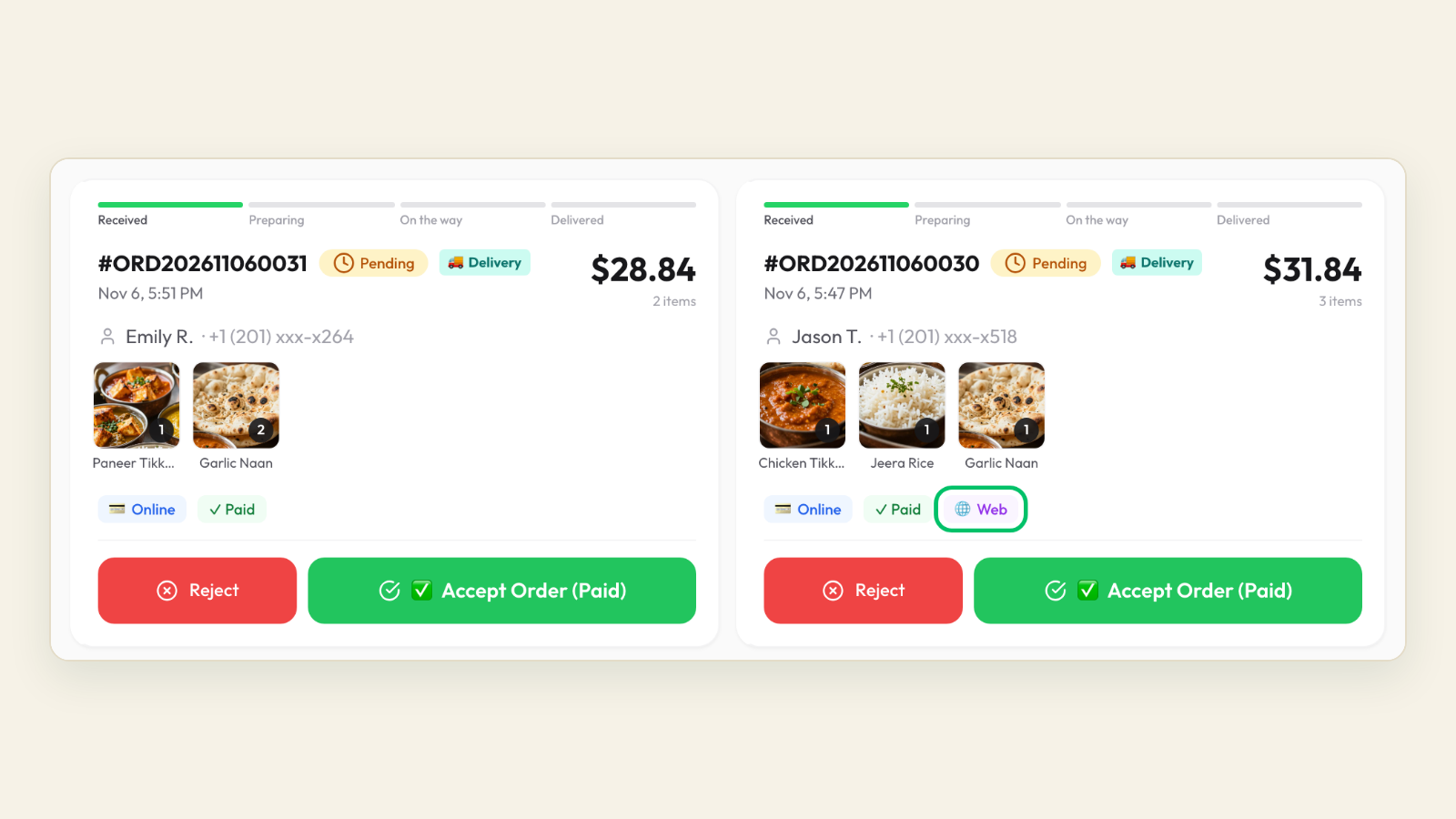
Tezzu is the direct ordering column of the table above. Your own WhatsApp number becomes an ordering channel through Meta's embedded signup, and you get a free store page at tezzu.in/store/your-name with a web menu that you can put on a custom domain and link from Google and Instagram. Customers order by message or on the page, pay by card through Stripe, and receive status updates on WhatsApp as the kitchen moves the order along.
Delivery zones with distance-based charges, self-pickup points with collection times, scheduled orders and pre-orders, combos, coupons that auto-apply, and reviews after each order are included. The kitchen uses the staff app, which gives new-order alerts. WhatsApp campaigns to your opted-in customers go out from the same number, funded from a prepaid wallet.
Plans for US merchants are $49, $69 and $99 a month plus $0.50 per order through Stripe, with no commission and a 7-day free trial on every plan. The full US setup is described in Tezzu for US merchants.
Put the three columns next to your own numbers
Take last month's marketplace statements and compare the commission lines with a flat fee per order. The pricing page shows what each Tezzu plan includes.
See pricingFrequently asked questions
Which delivery app is cheapest for a small restaurant in the US?
It depends on the plan and on who delivers. A split-fee app separates marketing commission, delivery commission and processing, so a self-delivering restaurant can pay less there, while a single-commission app's one percentage per tier is simpler and often similar in total when the app's drivers deliver. Compare net revenue per order from each on your own statements after a few months.
Can a restaurant be on more than one delivery app at the same time?
Yes, and most are. Listing on two widens reach, since customers tend to use one app. The cost is managing two tablets or an integration and two sets of promotions. Keep both on the lowest tier that still produces new customers, and move repeat customers to a direct channel so you are not paying commission twice on the same person.
What is the cheapest way for a small restaurant to take online orders?
A direct ordering channel with a flat per-order fee, such as a WhatsApp ordering platform with a store page, is usually the lowest cost per order once you have repeat customers. You pay a subscription, a small fixed fee per order and card processing, with no percentage commission, and you keep the customer's details for future offers.
Do delivery apps share customer data with restaurants?
Only in limited form. You generally see what you need to fulfil the order and some aggregate reporting, and the apps' terms restrict using their customer data to market off-platform. To build a customer list you can message, customers need to order on a channel you own, where they give you their number and consent directly.