Search for Indian restaurant online ordering USA options and you get a page of the delivery apps listings. That is odd, because the customers of an Indian restaurant in America are among the easiest in the country to move to a direct channel. They order the same dal and biryani every week, they place large family and party orders, they already live on WhatsApp to talk to relatives back home, and they find restaurants through community rather than through app search.
This guide explains what "commission-free" actually costs, how to set up a direct ordering channel that your customers will use, how to shift regulars off the apps without breaking any platform rules, and how to market an Indian restaurant to its community in the US.
Why Indian restaurants in the US are well placed for direct ordering
Most US restaurants struggle to move customers off the delivery app because those customers found them on the delivery app and have no other relationship with them. Indian restaurants are different in four ways.
- The customer base is a community. Families in Edison, Fremont, Sugar Land or Naperville hear about a restaurant from a temple, a cricket group, an office or a WhatsApp group of parents. Word of mouth is still the main discovery channel, and it works without an app.
- Orders repeat. A family that likes your Sunday thali orders it most Sundays. Repeat orders are exactly the ones where a 25 percent commission hurts most and is least needed.
- Tickets are large. Party trays, Diwali sweets, Navratri thalis and office catering run from $150 to several hundred dollars. Commission on those orders is painful, and the apps are not good at handling them anyway.
- WhatsApp is already installed. Many South Asian households in the US use WhatsApp daily for family abroad, so a WhatsApp ordering number needs no explaining. Our post on WhatsApp Business in the US covers who uses it and why it is growing.
What commission-free ordering actually costs
"Commission-free" never means free. It means you pay a fixed or per-order fee instead of a percentage of the ticket. The difference matters most on large, repeat orders. Here is how a $30 order looks on each channel; figures are illustrative and marketplace rates are as listed on their sites at the time of writing.
| Channel | Who holds the customer | Cost on a $30 order | Best used for |
|---|---|---|---|
| Marketplace app, middle tier | The app | About $7.50 at 25 percent, plus any offers you fund | New customers who do not know you |
| Marketplace-powered storefront (Storefront, Webshop) | Mostly the app | Card processing, roughly $1, plus a per-delivery fee if their couriers deliver | Customers who found you on the app and visit your website |
| Own WhatsApp and web ordering channel | You | Flat per-order fee of around $0.50 plus card processing of roughly $1.20, plus a monthly subscription spread across orders | Repeat customers, catering, pre-orders |
| Phone orders | You, if you write the number down | No platform fee; staff time and order errors | Older customers who prefer to call |
On 500 orders a month at a $30 average, the marketplace channel costs around $3,750 in commission. A direct channel on a $69 subscription with $0.50 per order and card processing costs around $920 all in. The exact marketplace figures are broken down in our guides to The delivery app commission fees and The delivery app commission.
Step 1: pick the channel your customers already use
You have three realistic options for direct ordering, and you can run more than one.
WhatsApp ordering
The customer messages your business number, a bot shows the menu, they pick items, choose delivery or pickup, pay by card and get status updates in the same chat. No app to install and no account to create. For an Indian restaurant this is usually the highest-adoption option, because the number can be shared in community groups and saved like any contact.
A web store page
A simple ordering page with your menu, linked from your Google Business Profile, Instagram bio and website. Customers who search your name on Google land here instead of on an app. Pair it with a custom domain so the link looks like yours.
Phone, kept but reduced
Some customers will always call. Keep the line, but have staff send the ordering link after each call so the next order comes in by itself.
The mistake to avoid is building a custom app. Adoption is poor, the build is expensive, and your customers already have WhatsApp and a browser.
Step 2: set up payments and delivery
Payments in the US for a direct channel almost always run on Stripe or a similar processor. You create an account with your business details and bank account, connect it to your ordering platform, and customers pay by card or any wallet option enabled on your Stripe account. Payouts typically arrive within a couple of business days once the account is established. Setup steps and fees are in Stripe for restaurants.
Delivery is the harder decision. Your options:
- Pickup first. Many Indian restaurant orders are already pickup, especially large family orders. Set pickup slots so the kitchen is not hit with ten party trays at 6 pm.
- Your own driver for a tight radius. A part-time driver for a three-mile radius during dinner can cost less per order than any third party once volume passes a few dozen orders a night.
- Courier services for orders you took yourself. The delivery app Drive and a ride-hailing app Direct deliver orders from your own channel for a flat fee per delivery rather than a commission. Useful for the long-distance orders you do not want to drive.
Set delivery zones with charges by distance so a customer 12 miles away pays a fair delivery fee rather than being refused or subsidised.
Step 3: move regulars off the apps within the rules
The marketplaces' terms generally prohibit using customer data they provide to market to those customers off-platform. Do not scrape names from the delivery app and message them. What you can do is make your own channel visible to every customer, wherever they came from.
- A card in every bag. "Order direct on WhatsApp, save the fees, get 10 percent off your first direct order." With a QR code to your number. This is the single highest-return tactic.
- Google Business Profile. Set your own ordering link as the primary order button. Customers who search your name should land on your page, not an app.
- Instagram and Facebook. Bio link to your store page; WhatsApp number in the profile; every food post ends with "order on WhatsApp".
- Community presence. Temple and gurdwara events, cricket leagues, Diwali melas, office lunch programmes. A table with sweets and a QR code does more for direct orders than a month of app ads.
- Catering as the entry point. Anyone who orders a party tray should do it on your channel, because the apps handle large orders badly. Once they have ordered catering direct, their weekly order follows.
The playbook for telling customers to skip the apps, with message wording and timing, is in order direct campaigns.
Step 4: market to the community on WhatsApp
Once customers order on WhatsApp, you have their consent to message them about offers, provided they opted in and you message in moderation. A realistic calendar for an Indian restaurant in the US looks like this.
- Weekly: a Thursday message with the weekend special or thali menu. One message, with a direct ordering link.
- Festivals: Diwali sweets and gift boxes on pre-order three weeks ahead; Navratri fasting menu; Eid, Onam, Pongal and Holi specials depending on your community. Pre-orders with advance payment stop you over-cooking.
- Cricket and events: match-day snack boxes during India fixtures, with a pickup slot before the toss.
- Win-back: a message to anyone who has not ordered in 45 days, with a small offer.
Keep it to one or two messages a week. The customers who block restaurants on WhatsApp do it because of daily promotions, and a blocked customer is worse than a customer on the delivery app.
What this looks like on Tezzu
Tezzu runs this whole setup for US restaurants. Your own WhatsApp number becomes an ordering channel through Meta's embedded signup, so customers message a number they already have. Alongside it you get a free store page at tezzu.in/store/your-name with a web menu, which you can put on a custom domain and link from Google and Instagram.
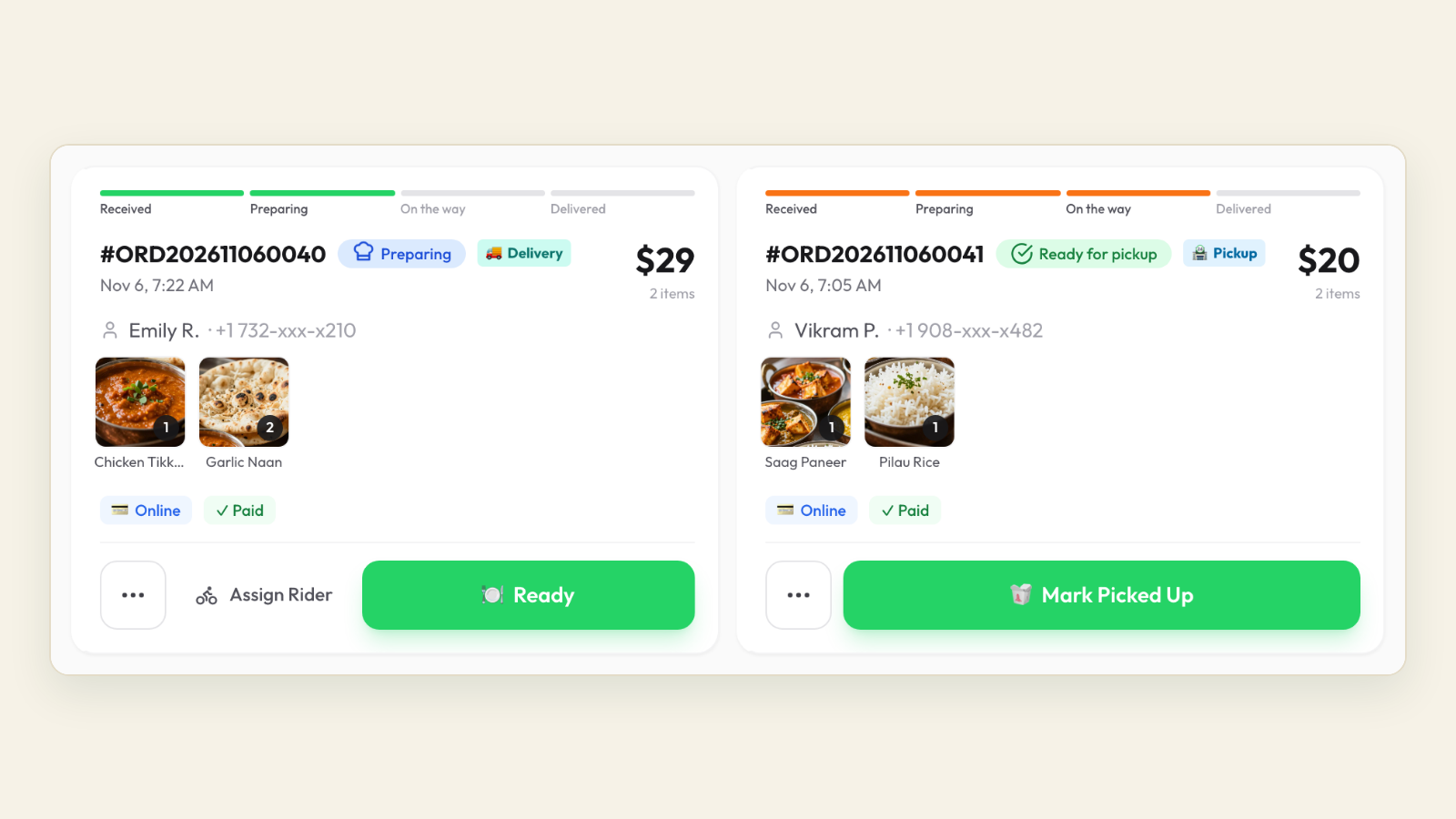
Customers pay by card through Stripe, with status updates sent on WhatsApp as the order moves from accepted to preparing to out for delivery or ready for pickup. Delivery zones with distance-based charges, self-pickup points with collection times, and scheduled orders and pre-orders cover the catering and festival orders that the apps handle badly. Bundles and combos work for thali and party-tray menus.
WhatsApp campaigns go out from the same number customers order on, funded from a prepaid wallet, and order reviews are collected automatically after delivery. Kitchen staff get new-order alerts on the staff app. Plans for US merchants are $49, $69 and $99 a month plus $0.50 per order, with no commission, and every plan starts with a 7-day free trial. Setup takes about 30 minutes. Details are in Tezzu for US merchants.
Walk through your menu and delivery setup on a call
Bring your current the delivery app statement. We will show you the WhatsApp flow, pickup slots and zones, and what the monthly cost looks like at your order volume.
Book a demoFrequently asked questions
What is the cheapest way for an Indian restaurant in the US to take online orders?
A direct channel with a flat per-order fee, such as WhatsApp ordering with a store page, is usually the lowest cost per order once you have regular customers. You pay a monthly subscription, a small per-order fee and card processing, with no percentage commission. Marketplaces remain useful for new customers who have never heard of you.
Will American customers order on WhatsApp?
Your Indian and South Asian customers almost certainly will, since many use WhatsApp daily. For customers who do not, a web store page covers them with the same menu and payment options, and the two channels share one dashboard. Most Indian restaurants find WhatsApp adoption is high because the number spreads through community groups.
Can I message the delivery app customers to order direct?
Not using data from the app, which the platforms' terms generally prohibit. You can put your own ordering link and QR code in every bag, on your Google listing and on social media. Once a customer orders on your channel and opts in, you can message them about offers from your own number.
How do I handle delivery without the delivery app?
Start with pickup, which many Indian restaurant orders already are, then add a part-time driver for a short radius during dinner. For longer distances, courier services such as the delivery app Drive or a ride-hailing app Direct deliver orders you took yourself for a flat fee per delivery, with no commission on the order.