An Indian grocery store USA WhatsApp number is already a sales channel, whether the owner planned it or not. Customers send a photo of a handwritten list, ask "do you have fresh methi this week", pay by Zelle, and someone's nephew drops the bags at a condo lobby on the way home. It works, and it is why these stores have loyal customers that national chains cannot reach. It also breaks at the first busy Saturday: lists get missed, prices are quoted from memory, nobody knows which Zelle payment was for which bag, and the driver has four stops written on a receipt.
This guide is for owners of Indian, Pakistani, Bangladeshi and other South Asian grocery and food stores in the US who want to keep the WhatsApp channel their customers love and make it reliable: a catalogue, pickup and delivery slots, card payments, sales tax handled, and marketing to the community without spamming it.
How Indian grocery stores already sell on WhatsApp, and where it breaks
Walk into most Indian grocery stores in Edison, Sugar Land, Irving, Fremont, Schaumburg or Decatur and ask how online orders work, and the answer is "they WhatsApp us". The flow is usually the same:
- The customer sends a list, often as a photo or voice note, sometimes in a mix of English and Gujarati or Hindi.
- A staff member reads it between serving walk-in customers, replies with what is available, and quotes a rough total.
- The customer pays by Zelle, Venmo or cash on pickup.
- Someone packs the bags and either holds them at the counter or drives them out after closing.
The failure points are predictable. Lists arrive on one phone that only one person can answer. Prices are quoted from memory and differ from the shelf. Substitutions are decided without asking. Payment matching is a nightly chore. And there is no record of who ordered what, so the store cannot tell its regulars that fresh mangoes arrived or that the Diwali sweet boxes are open for pre-order.
Some stores list on grocery delivery apps as an alternative, but those apps take a commission or mark up prices and keep the customer relationship, the same structure restaurants face with the marketplaces described in our guide to The delivery app commission fees. For a store whose customers already message it directly, paying a percentage for those same customers makes little sense.
What grocery customers actually want from the channel
Grocery orders differ from restaurant orders in ways that shape the setup.
- Repeat baskets. The same 20 staples every two weeks: atta, rice, dal, oil, spices, frozen parathas, paneer, yoghurt. A customer who can reorder last time's basket in two taps will.
- Fresh produce with variable availability. Methi, curry leaves, drumsticks, small brinjals, green chillies, mangoes in season. Customers want to know what is in stock today, and they accept substitutions if asked first.
- Pickup as the default. Most grocery customers drive. A pickup slot with the bags ready at the counter is what they want; delivery is for larger orders, older customers and bad weather.
- Festival and seasonal spikes. Diwali sweets and gift boxes, Navratri fasting items, Pongal and Sankranti ingredients, Ramadan dates and iftar essentials, Alphonso mango season. Pre-orders with payment stop you over-ordering stock.
- Trust on weight and price. Customers want the price they see to be the price they pay. Items sold by weight need a clear approach, which the next section covers.
Building a catalogue that works for groceries
A grocery catalogue is larger than a restaurant menu, so structure matters more than photography.
Categories that match how people shop
Staples, spices, fresh produce, dairy and paneer, frozen, snacks and sweets, pooja items, beverages, household. Keep the names in English with the common Hindi or regional term in the description, so "fenugreek leaves (methi)" is found either way.
Variants for pack sizes
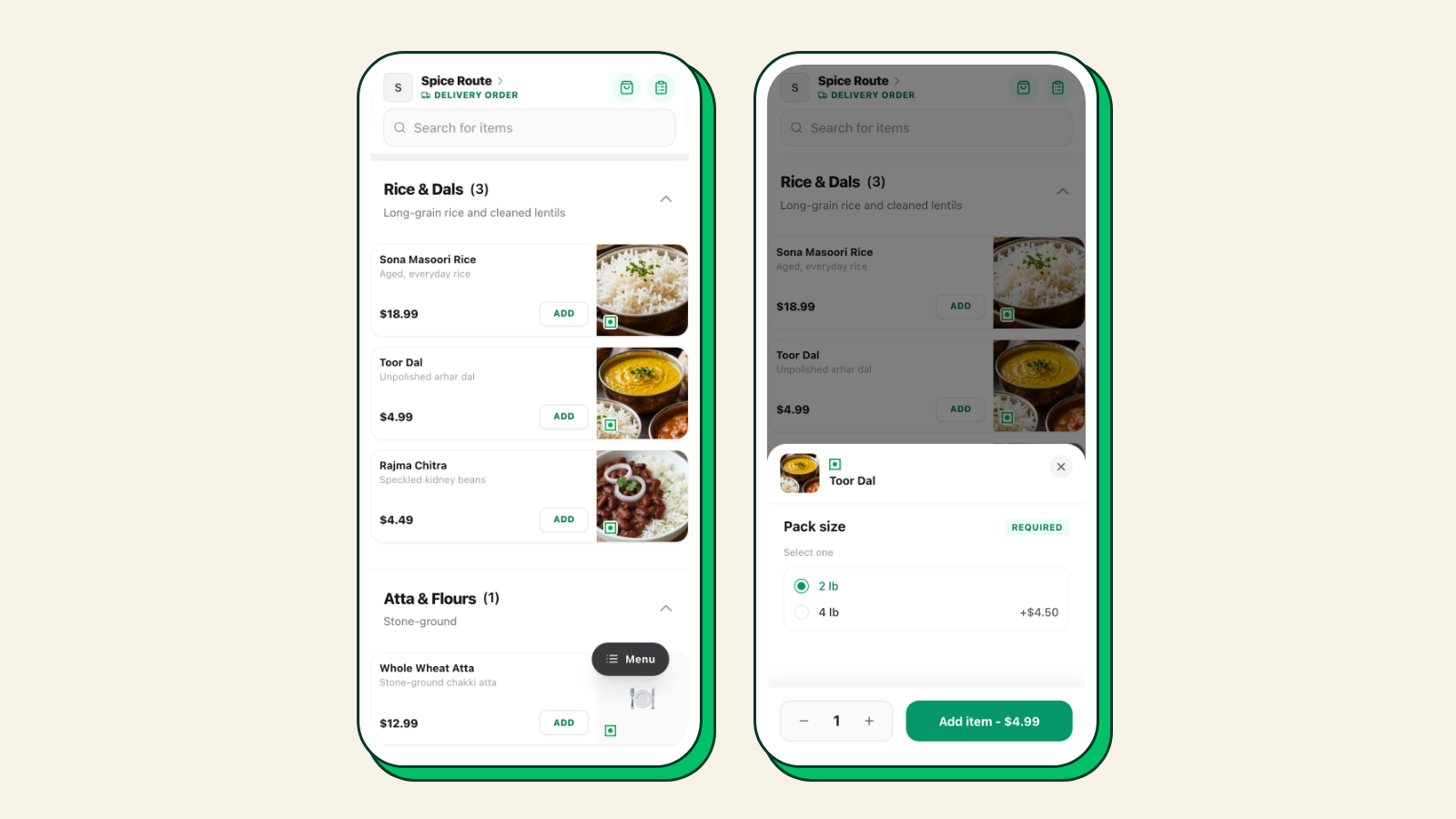
Sell by fixed pack sizes rather than open weight wherever possible: atta in 10 lb and 20 lb, rice in 10 lb and 20 lb, dal in 2 lb and 4 lb. Each size is a variant with its own price. For produce, use fixed bunches or approximate packs (a bunch of coriander, a 1 lb bag of green chillies) at a set price, and note that weight may vary slightly. The small loss on a slightly heavy bag is far cheaper than quoting and adjusting every order by hand.
Availability, not deletion
Mark produce out of stock when it runs out rather than removing it. It reappears when the Tuesday delivery arrives, and customers learn to check.
Bundles
A "monthly staples box" at a small discount, a "Diwali sweets box", a "new apartment starter kit" for students arriving in August. Build-your-own bundles, where the customer picks three dals and two rice types for a set price, move volume on your highest-margin lines.
If you also run a kitchen counter selling samosas, chaat or a weekend thali, it sits in the same catalogue as a category of its own, with pickup times tied to when the kitchen is open.
Pickup slots, delivery zones and scheduling
Most grocery WhatsApp orders should be pickup, and the store should decide when, not the customer. Set collection slots, such as every hour from 11 am to 8 pm, with a cut-off an hour before, so the packing staff work in batches rather than reacting to each message.
| Option | How to set it up | What it costs you | Best for |
|---|---|---|---|
| Store pickup | Hourly slots, bags labelled with the order number at the counter | Packing time only | Most orders; customers who drive past the store anyway |
| Delivery in a short radius | A zone of a few miles with a flat charge, free above a minimum basket | Driver time and fuel, in batches after lunch and after closing | Large baskets, older customers, bad weather |
| Delivery in a wider radius | A second zone with a higher charge and a higher free-delivery minimum | Longer runs; often one batch a day | Suburbs without an Indian store nearby |
| Scheduled orders | Customer picks a day; you pack the night before | Nothing extra; smooths the workload | Festival pre-orders, weekly standing baskets |
A delivery radius with distance-based charges stops the store from accepting a $35 order from 15 miles away. A free-delivery threshold on bigger baskets does the opposite: it nudges the $60 order to $80.
Payments and sales tax
Zelle and Venmo will not disappear. They do create the matching problem every evening. A card payment step inside the order, through Stripe, marks the order paid automatically and settles to your bank in a couple of business days. Wallet options enabled on your Stripe account make it a one-tap step on the phone. Keep cash on pickup for customers who prefer it, with the order marked paid at the counter. Setup and fees are in Stripe for restaurants; the process is identical for a store.
Sales tax on groceries varies by state and sometimes by item: many states exempt unprepared food and tax prepared food, snacks or sweets differently. On your own channel you apply and remit the tax yourself, so set tax rules per category with your accountant and check them against a few real orders.
Marketing to the community without annoying it
A grocery store's customer list is its best asset, and WhatsApp is the only channel where a message about fresh stock gets read the same afternoon. The rules: message only customers who have ordered or opted in, keep to one or two messages a week, and make it easy to reply "stop".
What to send:
- Fresh arrival days. "Produce delivery is in: methi, curry leaves, small brinjal, Alphonso mangoes by the box." Sent Tuesday afternoon, with the ordering link.
- Festival pre-orders. Diwali sweets and gift boxes opened three weeks ahead; Navratri and Pongal items a week ahead; Ramadan essentials before the month starts.
- Student season. A starter kit bundle in August, promoted in university and new-arrival WhatsApp groups.
- Weekly staples reminder. A gentle "reorder your usual" every two weeks to customers whose last order was a staples basket.
The channel itself spreads through the community. A card at the checkout with a QR code to your WhatsApp number, a line on the receipt, a post in the local temple or school parents' group, and your Google Business Profile order button all point to the same number. Why WhatsApp reaches these customers better than SMS or email is covered in WhatsApp Business in the US. For the Indian kirana equivalent of this setup, see kirana and grocery store WhatsApp ordering; the principles transfer, with dollars instead of rupees.
What this looks like on Tezzu
Tezzu connects your store's own WhatsApp number through Meta's embedded signup, so the number customers already message becomes the ordering channel. Your catalogue, built once with categories, pack-size variants and add-ons, is shown in the chat by a bot that takes the basket, the pickup slot or delivery address, and the payment, then confirms the order. The same catalogue is published on a free store page at tezzu.in/store/your-name, which you can put on a custom domain and link from Google and Instagram for customers who prefer a browser.
Self-pickup points with collection times, delivery zones with distance-based charges and per-zone free-delivery thresholds, scheduled orders and pre-orders for festivals, bundles and build-your-own bundles, coupons that auto-apply and promo banners on the store page are all included. Customers pay by card through Stripe or choose cash on pickup. Staff see every order on a live dashboard and on the staff app with new-order alerts, and WhatsApp campaigns to opted-in customers go out from the same number, funded from a prepaid wallet.
Plans for US merchants are $49, $69 and $99 a month plus $0.50 per order, with no commission and a 7-day free trial. The US setup is detailed in Tezzu for US merchants, and the restaurant-side version of this guide is commission-free ordering for Indian restaurants in the USA.
See a grocery catalogue on WhatsApp
Bring a photo of a typical customer list. We will show how it becomes a catalogue with pickup slots, delivery zones and card payment, and what the monthly cost looks like at your volume.
Book a demoFrequently asked questions
Can an Indian grocery store take orders on WhatsApp in the US?
Yes. Most already do informally. With the WhatsApp Business API connected to an ordering platform, the store's number shows a catalogue, takes the basket, pickup slot or address and payment, and confirms the order automatically, with several staff able to see and pack orders from one dashboard rather than one phone.
How do I sell produce by weight on WhatsApp?
Sell by fixed bunches or approximate packs at a set price, such as a bunch of coriander or a 1 lb bag of green chillies, and note that weight may vary slightly. Fixed pack sizes for staples, such as 10 lb and 20 lb atta, become variants with their own prices. Quoting open weight per order by hand does not scale past a few orders a day.
Should I offer delivery or only pickup?
Start with pickup slots, which most grocery customers prefer and which cost you only packing time. Add a short delivery radius with a flat charge and a free-delivery minimum for large baskets, delivered in one or two batches a day. A second, wider zone with a higher charge can follow once the first is running smoothly.
How do customers pay for WhatsApp grocery orders?
Through a card payment step in the order, which also takes digital wallets and marks the order paid automatically, or by cash at pickup. Zelle and Venmo can stay as options for regulars, but card payment in the flow removes the nightly job of matching transfers to bags.