WhatsApp ordering UK takeaways are asking about is a simple idea: the customer messages your business number, picks from a menu in the chat, pays by card and gets a message when the food is ready or on its way. It works, and it works best for exactly the kind of business that still takes half its orders by phone on a Friday night: the Indian, Chinese, pizza, kebab and fish and chip shops with a loyal local base that the delivery app charges a commission on every time they reorder.
This guide looks honestly at where WhatsApp ordering fits a UK takeaway, what it costs compared with the apps and the phone, how the flow works for customers, and the UK-specific details on payments, VAT, allergens and marketing consent.
Does WhatsApp ordering work in the UK? The short answer
Yes, with two conditions. Your customers need to use WhatsApp, which most UK adults do, since it is among the most used messaging apps in the country. And you need repeat customers, because the point of a direct channel is to take the second, fifth and twentieth order without paying a marketplace for it. A takeaway that gets most of its orders from people who have never heard of it should stay on the apps and add WhatsApp alongside, not instead.
It suits:
- Takeaways with a phone that rings all evening and a counter person who cannot keep up.
- Family-run Indian, Bangladeshi, Pakistani, Turkish and Chinese takeaways whose customers already message friends on WhatsApp and would happily message the shop.
- Shops that already deliver with their own drivers and pay the delivery app only for the order, not the delivery.
- Any takeaway doing collection orders, where no courier is involved and the only thing the app provides is the menu and the card payment.
It suits less well a city-centre lunch spot that depends on app search for walk-in-equivalent trade, or a business where most customers are students who rotate every year.
What UK takeaways pay today
Most UK takeaways run three or four channels at once. The cost of each differs more than owners usually realise. Commission figures below are ranges commonly reported by restaurant owners; the platforms negotiate per business and publish partial information, so check your own agreement and their current pricing pages.
| Channel | Pricing model | Commonly reported cost | Who holds the customer |
|---|---|---|---|
| The delivery app, you deliver | Commission on order value plus VAT, plus an admin or card fee per order | Mid-teens percent plus VAT and per-order fees | The delivery app |
| The delivery app, their couriers deliver | Higher commission to cover delivery | Well above the self-delivery rate | The delivery app |
| The delivery apps | Commission tiers, higher when their riders deliver | Commonly reported from around 20 to the mid-30s percent | The platform |
| White-label own app or website | Monthly fee, sometimes plus a per-order charge; card processing on top | Fixed monthly cost regardless of volume | You |
| Phone orders | No platform fee | Staff time, wrong orders, cash handling, no record | You, if someone writes the number down |
| WhatsApp ordering platform | Monthly subscription plus a small flat fee per order; card processing on top | Low cost per order, falls with volume | You |
Run the numbers on a £22 order. At a 14 percent commission plus VAT and a per-order fee, the delivery app with your own driver costs roughly £4 of the ticket. With platform delivery it can be £6 or more. A WhatsApp or web ordering channel with a flat per-order fee and card processing costs well under £1. On 150 repeat orders a week, the gap is several hundred pounds every week.
The phone is not free either. Staff time, misheard postcodes, no record of who ordered what, and no way to message the customer later all have a cost, which we work through in WhatsApp ordering vs phone orders.
How a WhatsApp ordering flow works for a takeaway
From the customer's side it is short.
- They tap your WhatsApp number from a flyer, your Google listing, a QR code on the menu or a link on Facebook, and send "hi".
- A bot replies with the menu grouped by category: starters, mains, sides, drinks. They tap items, choose options (rice or naan, mild or hot) and add them to a cart.
- They choose collection or delivery. For delivery, they share their postcode and address; the system checks it is inside your zone and adds the delivery charge.
- They pay by card or digital wallets through a payment step, or choose cash on collection if you allow it.
- They get a confirmation, then "preparing", then "ready for collection" or "out for delivery", in the same chat.
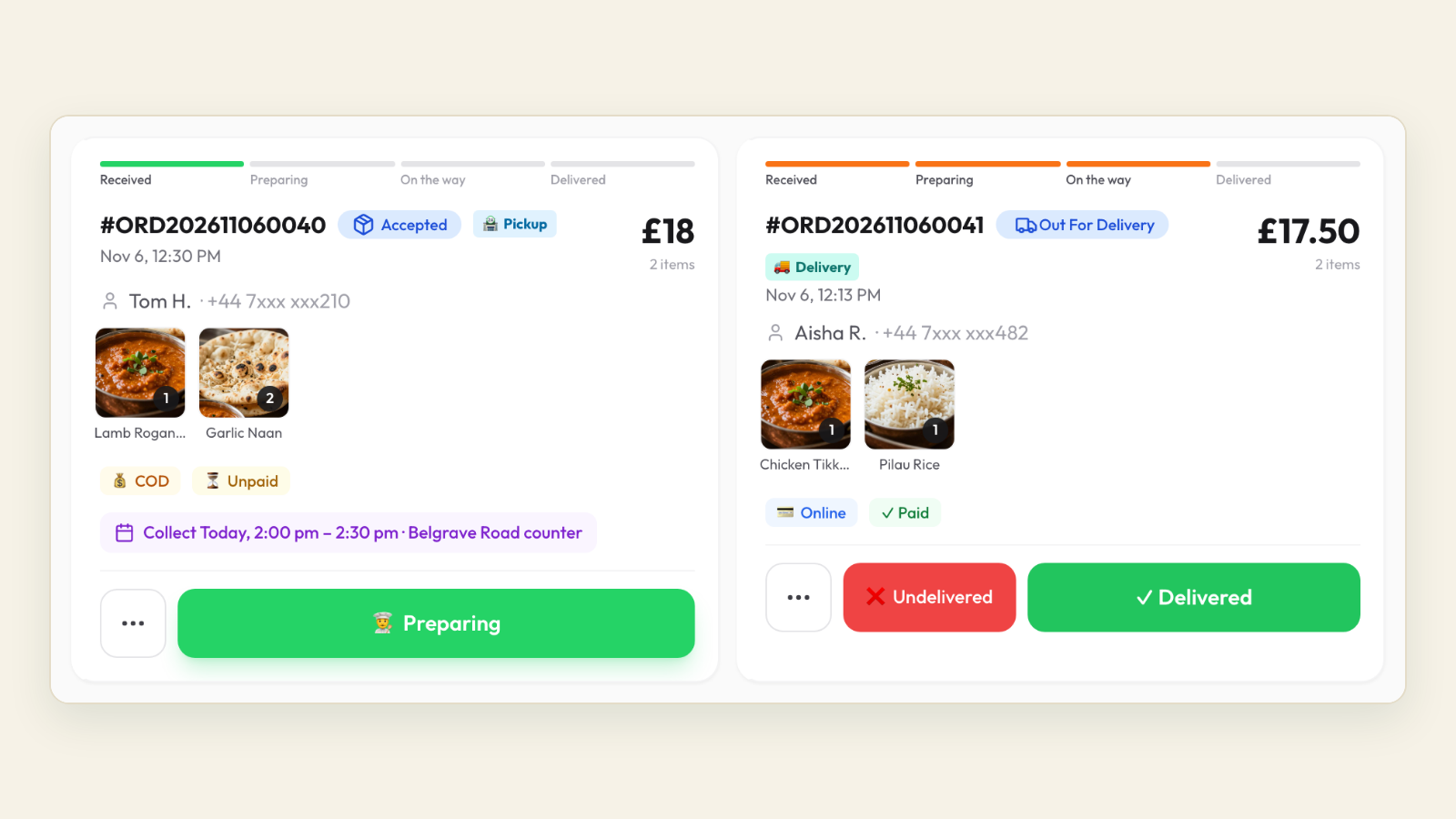
From your side, every order lands on a dashboard and a staff phone with a loud alert, prints to the kitchen if you want it to, and is updated with a tap. Nobody is on the phone, so the counter person is packing orders instead of spelling out postcodes. The whole menu is built once, so the Friday special or a sold-out item is changed in one place and the customer sees it immediately.
The difference between doing this with the free WhatsApp Business app and with the API through a platform is the difference between one phone with a human typing replies and a system that takes orders by itself. Our WhatsApp Business vs WhatsApp Business API guide explains the trade-offs.
Payments, VAT and allergens for UK takeaways
Card payments
UK customers expect to pay by card, digital wallets. A payment step inside the ordering flow handles this; the money settles to your business bank account through the gateway your platform uses, usually within a few business days. Cash on collection is still worth offering for older regulars, with the order marked paid when they pick up.
VAT
Hot takeaway food is standard-rated for VAT in the UK, and some cold items are treated differently. Your menu prices should be VAT-inclusive, and if you are VAT-registered your ordering system should produce a receipt that shows it. Check the treatment of specific items with your accountant.
Allergens
UK rules require allergen information to be available to customers for the food you sell. A digital menu makes this easier than a paper one: add allergen notes to item descriptions or a clear note telling customers to message with any allergy before ordering, and make sure staff see those messages before the order is cooked.
Hygiene rating
Customers in England, Wales and Northern Ireland look at your Food Hygiene Rating. Put it on your store page and in your WhatsApp greeting; it is a trust signal the apps display and you should too.
Collection, own drivers and delivery zones
Collection is where WhatsApp ordering pays off first for a UK takeaway. There is no courier, no delivery charge and no app involvement; the only thing a marketplace provides on a collection order is the menu and the card payment, and you can provide both yourself. Set collection slots so the kitchen is not handed 20 orders for 7 pm.
For delivery, most takeaways already have their own drivers. Set delivery zones by distance or postcode with a charge for each, free delivery above a minimum order if you want it, and a hard limit beyond which the system refuses rather than letting the counter accept an order from four miles away on a wet Saturday. Drivers get the address from the order; the customer gets "out for delivery" when it leaves.
If you do not have drivers, the marketplaces' courier-only services and local courier firms deliver orders you took yourself for a flat fee per drop, which is usually cheaper than commission on anything above a small ticket.
UK GDPR and PECR: marketing on WhatsApp legally
Taking an order on WhatsApp is a transaction, and sending the status messages that go with it is fine. Sending promotions is marketing, and in the UK that falls under UK GDPR and the Privacy and Electronic Communications Regulations. The practical rules:
- Get consent before sending offers. A tick box or a clear "reply YES to get our weekly deals" at the end of an order is the usual way. Keep a record.
- Make opting out easy and honour it immediately. "Reply STOP" in every promotional message.
- Keep frequency low. One message a week with a real offer is enough; daily messages get you blocked by customers and flagged by WhatsApp.
- Have a short privacy notice on your store page saying what you collect and why.
Done this way, a Thursday message with the weekend deal to a few hundred regulars is cheap and reliable. The consent wording that works without annoying people is in WhatsApp opt-in: how to get consent without annoying customers.
How Tezzu handles WhatsApp ordering for UK takeaways
Tezzu connects your own business WhatsApp number through Meta's embedded signup, so the number on your flyers and shop front becomes the ordering channel. A bot shows your menu with categories, variants and add-ons, takes collection or delivery, checks the address against your zones, and takes payment or records cash on collection. Orders arrive on a live dashboard and on the staff app with new-order alerts, and can print as a KOT on a thermal printer.
You also get a free store page at tezzu.in/store/your-name with a web menu, which you can put on your own domain and link from your Google Business Profile and Facebook page. Self-pickup points with collection times, delivery zones with distance-based charges and free-delivery thresholds, scheduled orders, combos and meal deals, coupons that auto-apply, WhatsApp campaigns from a prepaid wallet, and reviews after each order are included. Setup takes about 30 minutes; the steps are in how to set up WhatsApp ordering with Tezzu.
Tezzu's published plans are in rupees for India and in US dollars for US merchants, with a flat per-order fee and no commission. If you run a takeaway in the UK, book a demo to confirm currency, card payment options and VAT receipts for your setup before starting a trial. The same commission pattern you see with the delivery app applies to the US marketplaces, as our The delivery app commission guide shows, and the answer is the same: own the repeat order.
See the flow with your own menu
Bring your menu and your delivery postcodes. We will show the WhatsApp ordering bot, collection slots and zones, and confirm what is available for a UK takeaway.
Book a demoFrequently asked questions
Can a UK takeaway take orders through WhatsApp?
Yes. With the WhatsApp Business API connected to an ordering platform, customers message your number, pick from a menu in the chat, pay by card and receive status updates automatically. The free WhatsApp Business app also works for small volumes, but every order then depends on a person reading and replying by hand.
Is WhatsApp ordering cheaper than the delivery app?
For repeat customers, usually by a wide margin. The delivery app charges a commission on each order plus VAT and per-order fees, while a WhatsApp ordering platform charges a monthly subscription and a small flat fee per order, with card processing on top. On a typical £20 to £25 order the difference is several pounds. The delivery app still earns its fee on customers who would not otherwise have found you.
Do I need consent to send offers on WhatsApp in the UK?
Yes. Order confirmations and status updates are part of the transaction, but promotional messages are marketing under UK GDPR and PECR and need the customer's consent, with an easy way to opt out. Ask at the end of an order, keep a record, include "reply STOP" in every promotion, and keep to about one message a week.
How do customers pay for a WhatsApp order?
Through a card payment step inside the flow, which accepts debit and credit cards and usually digital wallets, with the money settling to your business bank account through the payment gateway. Many takeaways also allow cash on collection for regulars, marking the order paid when it is handed over.