A restaurant CRM is a list of your customers with their phone numbers, what they ordered and when, and a way to message them. That is the whole thing. The question of whether a small restaurant needs one is really the question of whether you want to know who your customers are, and the answer for most owners is yes, as long as it does not mean a second piece of software to log into every night.
This guide covers what a CRM does in a restaurant, what a single outlet or cloud kitchen actually needs from one, where the customer data comes from in the first place, three ways to get one with their real costs, the signs that you need one now, and how an ordering platform can give you most of it without a separate tool.
What a restaurant CRM actually is
CRM stands for customer relationship management, which sounds like something a bank needs. In a restaurant it comes down to four jobs. Keep a record of each customer: number, name if you have it, address for delivery. Keep their order history: what, when, how much, how often. Let you find groups within the list: first-timers, regulars, people who have gone quiet, people who always order the family pack. And let you message those groups, on a channel they read.
Everything else that CRM software sells, from pipelines to lead scoring, is built for sales teams and is noise for a restaurant. The useful test for any tool is whether it does those four jobs with the data you already generate by taking orders, without anyone typing customer details in by hand.
What a small restaurant needs from one
A 40-seat restaurant or a cloud kitchen doing 60 orders a day has specific needs, and they are narrower than a chain's. The table separates what matters from what sounds impressive.
| Job | What you need | What you can skip |
|---|---|---|
| Customer record | Phone number, name, delivery address, captured automatically from orders | Email, demographics, manual data entry |
| Order history | Every order with items, amount and date, per customer | Interaction logs, notes fields nobody fills in |
| Grouping | First-timers, regulars, lapsed customers, high spenders, by order count and recency | Lead stages, pipelines, scoring models |
| Messaging | WhatsApp campaigns to a chosen group, with opt-out handling | Email sequences, SMS for a customer base that lives on WhatsApp |
| Feedback | A rating after each order, attached to the customer | Long surveys, NPS dashboards |
| Reporting | Repeat order share, new vs returning customers, lapsed count | Attribution models, funnel analytics |
If a tool does the left column from your order data, it is a restaurant CRM whatever it calls itself. The groups in the third row are the part that turns a list into money, and restaurant customer segmentation covers how to use them.
Where the customer data comes from
This is the part that decides everything. A CRM is only as good as the orders that feed it, and most Indian restaurants take most of their orders on channels that do not give them the customer.
The delivery app orders arrive with a masked number and no history you can keep. Phone orders give you a number only if someone writes it down. Walk-ins give you nothing unless you ask. Instagram DMs give you a username. None of these build a list on their own, which is why so many owners who try a CRM find it empty after a month.
WhatsApp ordering is the exception. Every order comes from a phone number, with the items, the amount, the address and the time, and the customer has already opened a conversation with you, which is the opt-in you need to message them later. A direct ordering channel is a CRM feeding itself. The legal side of building the list, including consent and opt-outs, is in how to build a WhatsApp customer list legally.
Three options compared
There are three realistic ways for a small restaurant to get a CRM. Each works; they differ in effort and in how much they cost, in money and in evenings.
| Option | How it works | Strengths | Weaknesses |
|---|---|---|---|
| Spreadsheet | Orders typed or exported into a sheet; filters for groups; messages sent by hand | Free; you understand every column | Falls behind in a busy week; messaging 200 people by hand from a phone; no feedback loop |
| Standalone CRM or WhatsApp marketing tool | A separate subscription that holds contacts and sends campaigns | Strong messaging features; segmentation | Orders live elsewhere, so history has to be imported; another login; often priced per message or per contact |
| Ordering platform with customer insights | Orders on your WhatsApp number feed a dashboard with customer history, groups and campaigns | No data entry; order history is complete; feedback and messaging in the same place | Only covers orders through that channel; you have to move orders direct for it to fill |
The spreadsheet is the right answer for a home baker doing 30 orders a month. The standalone tool is the right answer for a chain with a marketing person. For a single restaurant or cloud kitchen doing a few dozen orders a day, the third option is usually the one that gets used, because it fills itself and lives where the orders already are.
Signs you need one now
You do not need a CRM on day one. You need one when any of these is true.
- You cannot say how many of this month's orders came from customers who had ordered before.
- You have run a WhatsApp offer by forwarding a message to saved contacts from a phone, and it took an evening.
- A regular stopped ordering and you noticed a month later, if at all.
- Most of your orders come from aggregators and you have no way to reach those customers directly.
- You want to run a loyalty reward, a win-back or a referral and have no list to send it to.
- Two people answer the business phone and neither knows what the customer ordered last time.
Each of these is a symptom of not knowing your customers. The fix is the same in every case: take orders on a channel that records who ordered, and look at the list once a week. The restaurant customer retention guide explains what to do with the list once it exists, and personalised offers from order history shows the first thing most owners do with it.
What this looks like on Tezzu
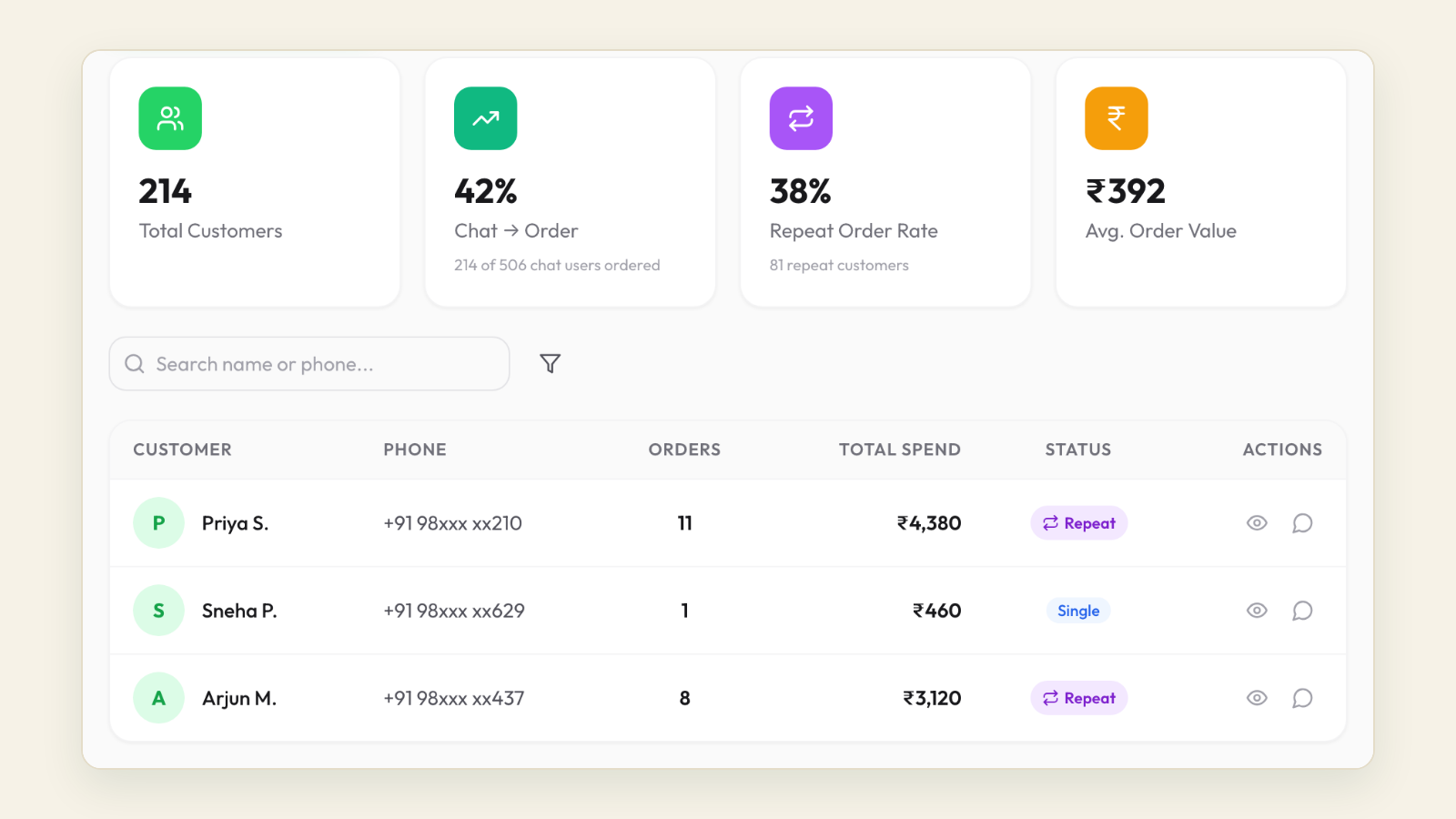
Tezzu is an ordering platform rather than a CRM, but it does the four jobs above as a side effect of taking orders. Orders arrive on your own WhatsApp number and on a free store page, so every customer's number, address and order history are captured without anyone typing. The live dashboard shows orders, revenue and customer insights, which is where you see your customers and their orders in one place; understanding your live dashboard walks through the screens.
Messaging is built in: WhatsApp campaigns go out from the dashboard to the customers you choose, paid from a prepaid wallet, and a rating is collected after every delivery and attached to the order. Coupons that can auto-apply cover loyalty, win-back and referral rewards. There is no per-contact pricing: plans start at ₹999 a month with a flat ₹10 per order and no commission, and every plan begins with a 7-day free trial.
Let your orders build the customer list
Take orders on your own WhatsApp number and see customer history, ratings and campaigns in one dashboard, free for 7 days.
Start your free 7-day trialFrequently asked questions
What is a CRM for a restaurant?
A record of each customer with their phone number, order history and a way to message them. In practice it does four jobs: store customer details captured from orders, keep what each person ordered and when, group customers into first-timers, regulars and lapsed, and send WhatsApp messages to a chosen group. Sales-style features like pipelines and lead scoring are not needed.
Do small restaurants need CRM software?
They need the list, not necessarily separate software. A home baker can run it in a spreadsheet; a single restaurant or cloud kitchen doing a few dozen orders a day usually does better with an ordering platform whose dashboard records customers and order history automatically, because a tool that needs manual data entry stops being updated in the first busy week.
How do restaurants collect customer data in India?
Mostly through WhatsApp ordering, where every order carries a phone number, address and items, and through asking at the counter for a number for the bill or delivery update. Aggregator orders mask the customer's number, so restaurants that depend on them have little data to work with. Consent for later marketing comes from the customer having started the conversation, with opt-outs honoured.
What is the best CRM for restaurants in India?
It depends on where your orders come from. If most orders arrive on your own WhatsApp number, an ordering platform with customer insights and built-in campaigns does the job without a separate subscription. If you already have a list and mainly want messaging, a WhatsApp marketing tool fits. Judge any option on whether it fills itself from orders and messages on WhatsApp.