WhatsApp vs email marketing is an uneven contest for a food business in India, and the reason is not open rates. It is that your customers give you a phone number when they order and almost never give you an email. WhatsApp message open rates are generally reported far above email, but the bigger gap is upstream: a restaurant can build a WhatsApp list of 2,000 real customers from orders in a few months, and would struggle to get 200 working email addresses in the same time. Email still earns a place for catering quotes, corporate tiffin contracts and anything long enough to need a document.
This comparison covers list building, attention, cost, content, rules and the cases where each channel is the right one.
The comparison at a glance
| Factor | Email marketing | WhatsApp marketing (Business API) |
|---|---|---|
| Cost per message | Close to zero at restaurant volumes; most tools have free or low tiers | Under a rupee per marketing template in India at the time of writing |
| How you get the address | Customers rarely give email for a food order; needs a separate ask | Every WhatsApp order and most store page orders capture the number |
| Where it lands | Inbox, often the promotions tab or spam | The chat list, next to family and friends |
| Open and read rates | Generally reported low for retail and restaurants | Generally reported far higher; measure your own |
| Time to being read | Hours to days, if at all | Usually minutes |
| Length and format | Long-form, images, PDFs, full catalogues | Short body, one image or video, buttons |
| Customer can reply and order | Reply is rare; ordering needs a website | Reply and order in the same chat |
| Approval before sending | None | Marketing templates approved by Meta |
| Consent rules | Unsubscribe link, consent under DPDP | Meta opt-in policy, quality rating, DPDP |
| Frequency tolerance | Weekly or more is accepted | About weekly for offers; more gets blocks |
| Best restaurant use | Catering proposals, corporate tiffin, monthly statements, GST invoices | Offers, launches, order conversations, win-back, reviews |
List building: the gap that decides everything
Marketing channels are only as good as the list behind them. For a restaurant, the WhatsApp list builds itself: a customer who orders on your number has given you the number and opened a conversation. A store page checkout captures it too. A QR on the table does the same. The full set of sources is in how to build a WhatsApp customer list legally.
An email list has no equivalent. Nobody emails a dhaba to order dinner. Collecting email means adding a field at checkout that people skip or fill with nonsense, or running a sign-up form that a handful of regulars complete. After six months, a typical restaurant has a few hundred email addresses of uncertain quality against thousands of verified phone numbers. The best-written email campaign cannot overcome that.
The exception is business customers. An office manager arranging daily lunch for 40 staff has a work email and expects to be contacted on it. A wedding planner wants the catering quote as a PDF. Those relationships live on email, and WhatsApp is the follow-up channel rather than the main one.
Attention: where the message lands
A WhatsApp message lands in the same list as messages from family, with your restaurant's name and photo, and most people look at that list many times a day. An email lands in an inbox that, for many Indian consumers, is checked rarely and filtered into a promotions tab by default. The widely reported gap in open rates between the two channels follows from that difference in attention, and it is why you should not compare them on cost per message alone.
The flip side is that attention is a shared resource. Customers tolerate a weekly email they ignore. They do not tolerate a daily WhatsApp message, and they have a block button. WhatsApp's advantage in attention comes with a stricter limit on how often you can use it.
Cost per message versus cost per order
Email is close to free at the volumes a restaurant sends. WhatsApp marketing messages are charged per template delivered, under a rupee each in India on Meta's rate card at the time of writing, and platforms may add a subscription. Per message, email wins outright.
Per order, the arithmetic depends on how many recipients read the message and can act on it. Suppose a weekend offer goes to 2,000 customers on each channel. If the email is read by a small fraction and produces 10 orders, the cost per order is low but the revenue is ₹4,000 at a ₹400 average. If the WhatsApp message costs ₹2,000 and produces 60 orders, that is ₹33 of messaging per order and ₹24,000 of revenue. Both sets of numbers are illustrative, but the structure holds: a channel that produces six times the orders is worth paying per message for. How to measure your own is in WhatsApp marketing ROI.
Content and rules on each channel
What each channel carries well
Email carries length. A full festive catalogue with twelve gift boxes and prices, a catering proposal with menus and terms, a monthly statement for a corporate tiffin account, a GST invoice as a PDF. All of these are awkward on WhatsApp and natural on email.
WhatsApp carries action. An image of the new biryani, three lines of text, a button that opens the menu, and a payment that completes in the same chat. It also carries conversation: the customer can ask whether the biryani is spicy and get an answer from your staff. Emails are rarely replied to, and when they are, the reply often goes unseen.
A practical split: anything the customer needs to read sits in email, anything the customer needs to do sits on WhatsApp.
Rules and approval
Email has no gatekeeper. You write it, you send it, and the only checks are your mail tool's spam scoring and the unsubscribe link you are required to include. Deliverability depends on technical setup, such as authenticating your sending domain, which most small restaurants never do, so a share of email simply lands in spam.
WhatsApp has Meta in the middle. Marketing messages outside the 24-hour reply window must be approved templates, customers must have opted in, and your quality rating, driven by blocks and reports, sets how many people you can message each day. These rules are stricter, but they are also why the channel stays readable: the same throttling that limits you limits every spammer. India's DPDP Act applies to both channels, since a phone number and an email address are both personal data.
Where each channel wins, and how to use both
Where email wins for a food business
- B2B relationships. Corporate tiffin contracts, office catering, event planners. The buyer works on email and wants documents. Our guide to tiffin service for corporate offices covers that sales process.
- Long-form content. Festive catalogues, full menus with photos, seasonal newsletters for customers who like reading them.
- Records. Invoices, monthly statements, receipts for bulk orders.
- Customers who asked for email. A small number of people prefer it. Respect that.
Where WhatsApp wins
- Everything meant to produce an order today. Offers, launches, slow-day pushes, win-back.
- Order conversations. Confirmation, status, delay, review request.
- Anything that benefits from a reply. Custom cakes, catering follow-ups after the proposal, tiffin skip-days.
- Reaching customers you already have. The list exists because they ordered.
Using both without doubling the work
Run WhatsApp as the primary channel for consumers and email as the primary channel for business accounts, and let each one hand off to the other at the natural point. A catering proposal goes by email; the "did you get a chance to look at it" follow-up goes on WhatsApp. A weekend offer goes on WhatsApp; the monthly loyalty statement, if you run one, goes by email. Keep one calendar so the same customer does not get both on the same day. SMS fills the remaining gap, covered in WhatsApp vs SMS marketing for restaurants, and the overall plan is in our complete guide to WhatsApp marketing for restaurants.
What this looks like on Tezzu
Tezzu handles the WhatsApp side. Customers order through a bot on your own WhatsApp number, connected to the WhatsApp Business API through Meta's embedded signup, or on your free store page at tezzu.in/store/your-name. Each order puts the customer in your live dashboard with their history, which is the list-building advantage described above happening automatically. Campaigns are composed in the dashboard, funded from a prepaid wallet, and sent to the customers you choose; the orders they produce show up in the same dashboard with revenue and customer insights.
Coupons can auto-apply so the offer in the message works without a code, promo banners on the store page repeat the offer for customers who arrive from elsewhere, and after delivery the customer gets a review request in the same chat. Every order is a flat ₹10 with no commission.
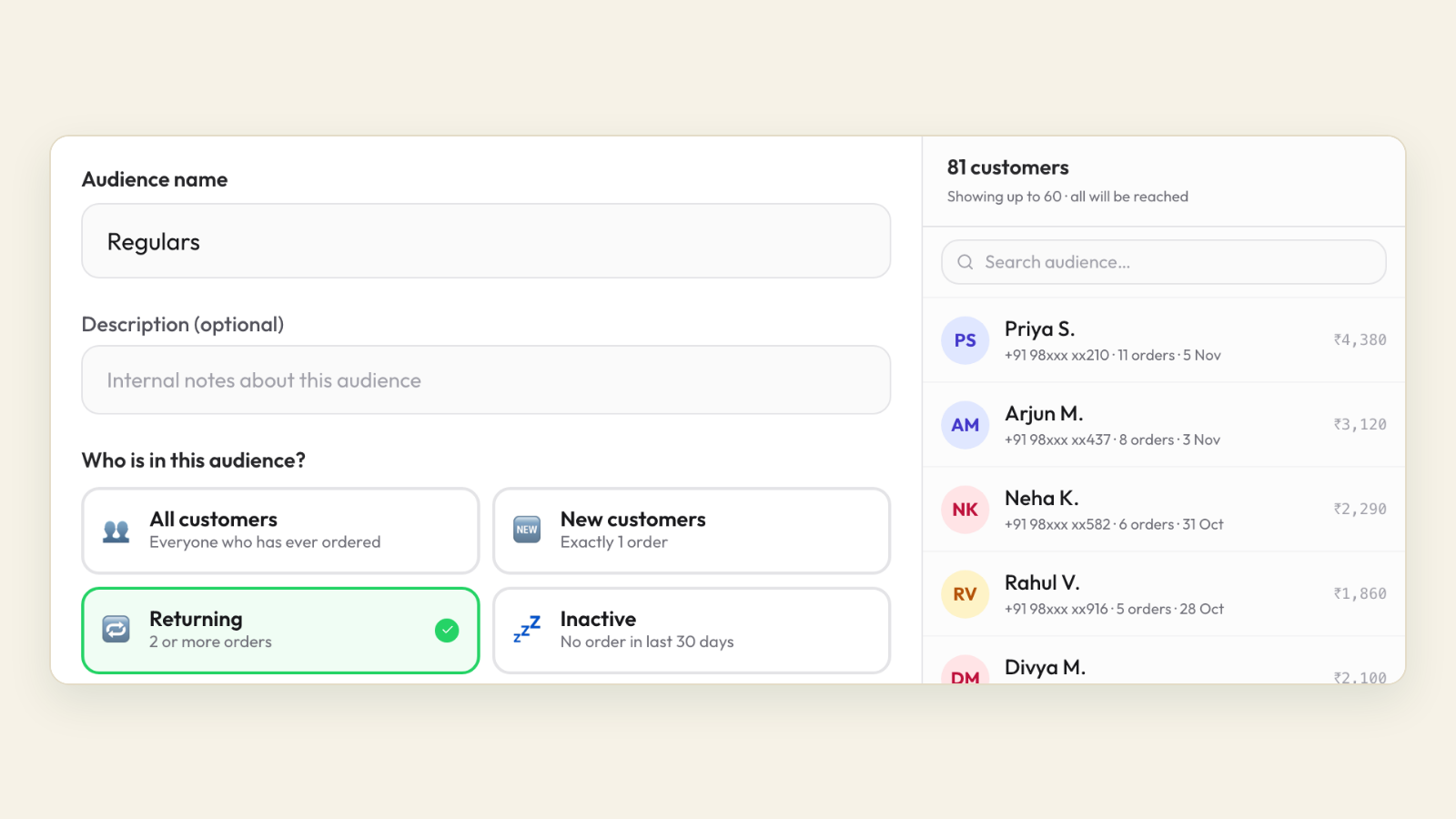
The first-campaign steps are in sending your first WhatsApp campaign from Tezzu.
Build the list from orders, then message it
Take orders on your own WhatsApp number and every customer is on your list the moment they order. Try it free for 7 days.
Start your free 7-day trialFrequently asked questions
Is WhatsApp better than email for restaurant marketing?
For consumer offers and anything meant to produce an order, yes. Restaurants collect phone numbers naturally through orders and almost never collect emails, WhatsApp messages are generally read far sooner and far more often than marketing emails, and the customer can order inside the chat. Email remains better for business customers, long documents such as catering proposals, and records like invoices.
What is the open rate of WhatsApp compared to email?
WhatsApp open rates are widely reported to be several times higher than email open rates, which for retail and restaurant campaigns are generally low. Published figures vary by source and are easy to overstate, so treat them as a direction rather than a number and measure your own: on the WhatsApp Business API you can see sent, delivered and read counts for every campaign.
Is email marketing free for a small restaurant?
Nearly. Common email tools offer free or low-cost tiers that cover a few hundred to a few thousand contacts, and sending costs almost nothing per message. The real cost is the list, which restaurants find hard to build, and deliverability, which needs domain setup most small businesses skip. WhatsApp costs per message but comes with a list that grows from every order.
Can I use WhatsApp and email together?
Yes, and for a food business with both consumer and business customers it is the sensible setup. Use WhatsApp for consumer offers, order conversations and follow-ups, and email for proposals, catalogues, statements and invoices. Keep a single campaign calendar so no customer receives both on the same day, and respect each customer's stated preference where they have one.