WhatsApp abandoned cart recovery is the follow-up you send when a customer starts a food order on your number or store page and stops before paying. In e-commerce the recovery window is days. In food it is minutes, because the customer is hungry now and will order from someone else by the time a next-day email arrives. A well-timed WhatsApp message, sent while the order is still relevant, is one of the few things that works.
This guide covers where food orders actually stall, a three-message sequence with timings, templates you can copy, and the checkout fixes that stop the carts being abandoned in the first place.
Where food orders stall
An abandoned cart on WhatsApp or a store page is rarely a customer changing their mind about dinner. It is usually a specific step that stopped them. The four common ones:
- The delivery step. They typed the address and saw a ₹60 delivery charge on a ₹250 order, or found they were outside your zone, or the minimum order was higher than their cart.
- The payment step. The UPI app did not open, the OTP did not arrive, or they wanted cash on delivery and it was not offered.
- The menu step. They added two items, got a call, and the chat went quiet. Nothing was wrong; life happened.
- The confirmation step. The order was placed but needed a payment that never completed, so it sits as pending.
Each needs a different message. A customer who hit a payment error needs a working payment link. A customer who got distracted needs a nudge. A customer who baulked at the delivery charge needs either a reason or a small concession. If you can see which step they stopped at, your recovery rate goes up sharply.
Why food is different from e-commerce recovery
Three things change the playbook. The decision window is short: lunch is decided by noon and dinner by 8:30 pm, so a message at 10 am the next day is a new sale, not a recovery. The order value is low, usually ₹200 to ₹600, so a 10% recovery discount is ₹20 to ₹60 and cannot carry much message cost. And the customer has already messaged you, which on the WhatsApp Business API opens a 24-hour window where you can reply with free-form text at no charge and without a pre-approved template.
That last point is the opportunity. The first two recovery messages fall inside the window and cost nothing. Only a next-day follow-up needs an approved template, and it should be treated as a win-back rather than a cart message. Templates are covered in how to get WhatsApp templates approved.
The three-message recovery sequence
| Message | When | Purpose | Costs |
|---|---|---|---|
| Nudge | 10 to 15 minutes after the last customer action | Remind them the cart exists, offer to complete it in one tap | Free, inside the 24-hour window |
| Help | 45 to 60 minutes after, only if no reply | Address the likely blocker: payment link, COD option, delivery query | Free, inside the window |
| Next-meal offer | Next day, before the same meal time | Small incentive to order today; really a win-back | Marketing template, charged per message |
Stop after three. A fourth message about one forgotten cart is the kind of thing that gets reported, and reports lower the quality rating that sets your messaging limit. Keep the third message optional; for a ₹220 cart it is often not worth sending at all.
Abandoned cart message templates for WhatsApp
Replace the bracketed parts. The first four go out inside the 24-hour window as plain messages; the last two are marketing templates for the next day.
Nudge, generic
Hi [Name], your order from [Restaurant] is still waiting: 1 chicken biryani and 1 raita, ₹329. Tap below to complete it and we will start cooking right away.
Nudge, delivery charge was the blocker
Hi [Name], your [Restaurant] cart is ₹250, and delivery to [area] is ₹40. Add any item worth ₹100 or more and delivery is free. Reply MENU to see what fits.
Help, payment did not complete
Hi [Name], it looks like the payment for order #[number] did not go through. Here is a fresh UPI link: [link]. If you would rather pay cash on delivery, reply COD and we will confirm.
Help, outside delivery zone
Hi [Name], [area] is just outside our delivery zone right now. You can pick up from [Restaurant] at [address], and we will have it ready at a time you choose. Reply PICKUP and a time.
Next day, small offer
Hi [Name], you nearly ordered the paneer tikka from [Restaurant] yesterday. It is on today too. Here is ₹50 off if you order before 9 pm: code BACK50. Reply ORDER to use it.
Next day, no offer
Hi [Name], [Restaurant] is open for dinner till 10:30 tonight. Your usual is one tap away: [link]. Reply STOP if you do not want reminders.
Notice that none of the messages begins with "You left items in your cart". Say what the items were and what it costs to finish. The customer forgot the details, not the fact that they were hungry.
Fix the causes, not just the symptom
Recovery messages are a patch. The bigger gains come from removing the step that stopped the customer.
- Show delivery charges before the address step. A zone map or a "delivery from ₹20, free above ₹399" line on the menu removes the surprise. Per-zone free-delivery thresholds turn the charge into an upsell.
- Offer cash on delivery alongside UPI. A share of customers abandon purely because they cannot pay online at that moment. COD recovers them at the cost of a little risk.
- Make the payment step work on the first try. Failed UPI intents and expired links are a large cause of pending orders. The diagnosis is in payment failures at checkout.
- Keep the minimum order realistic. A ₹300 minimum when your average item is ₹120 forces awkward third items. Set it at or just under the average basket.
- Auto-apply coupons. A code the customer has to remember and type is a step; a code that applies itself is not. Fraud and structure rules are in restaurant coupon codes.
Measuring whether it works
Track four numbers a week: carts started, orders completed without a nudge, orders completed after a nudge, and messages sent. Recovered orders divided by nudges sent is your recovery rate; recovered revenue minus discounts and message cost is what the sequence is worth. If the next-day template is costing more in messages and discounts than it brings back, drop it and keep only the free in-window messages.
Compare the recovery rate by stall reason too. If payment-stage carts recover at a much higher rate than delivery-stage carts, the delivery charge is your real problem, and the fix is a pricing change rather than a message. The wider measurement approach is in our complete guide to WhatsApp marketing for restaurants, and the longer-horizon version of this, for customers who have not ordered in weeks, is in WhatsApp win-back campaigns.
What this looks like on Tezzu
Tezzu's approach is to remove the steps where food orders die. The ordering bot keeps the whole order inside the customer's WhatsApp chat on your own number, and the free store page at tezzu.in/store/your-name does the same in a browser with no app download. Delivery zones with distance-based charges and per-zone free-delivery thresholds are shown as part of the order, so the charge is never a surprise at the end. Payment is UPI or card through Razorpay, with cash on delivery as an option you can switch on, and coupons can be set to apply automatically.
Every customer who starts an order is in the live dashboard, so the next-day follow-up is a campaign you send from the prepaid wallet to the customers you choose, with the orders it produces showing up in the same dashboard. Pending and completed orders are visible to your staff on the staff app with new-order alerts, so the in-window help message can go out while the customer is still hungry.
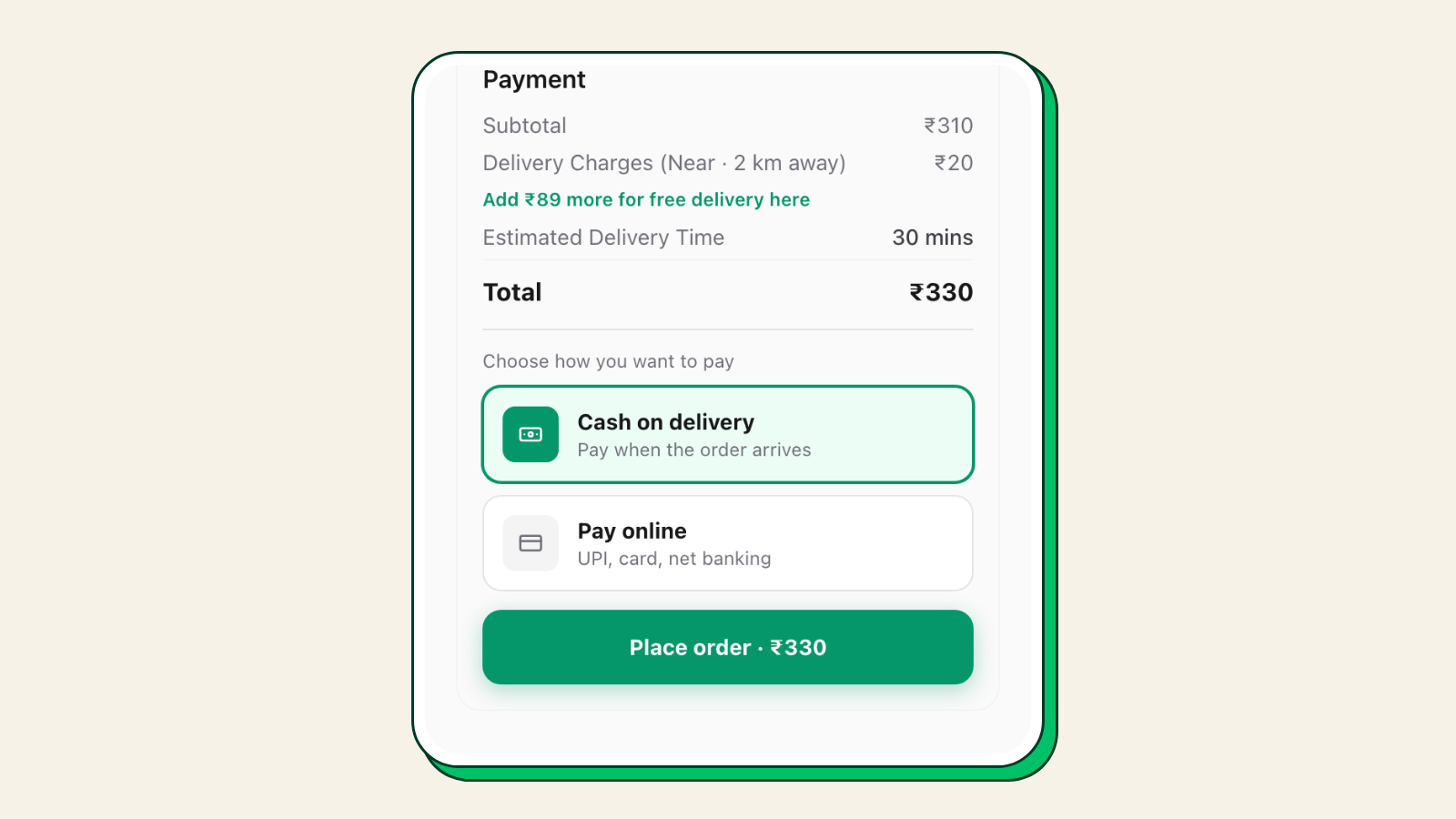
The store page checkout flow is described in your Tezzu storefront and web menu.
Close more of the orders that get started
Put the menu, delivery charges and UPI payment inside one WhatsApp chat so fewer customers stall. Free for 7 days.
Start your free 7-day trialFrequently asked questions
What is an abandoned cart message on WhatsApp?
It is a message sent to a customer who added items to an order on your WhatsApp number or store page but did not complete payment. For food, it is sent within minutes, names the items and the total, and offers one tap to finish. Because the customer messaged you first, the first follow-ups fall inside WhatsApp's 24-hour reply window and need no pre-approved template.
How soon should I send an abandoned order reminder for food?
Ten to fifteen minutes after the customer's last action, while they are still deciding what to eat. A second message around an hour later can address a specific blocker such as a failed payment. Anything after the meal time has passed is a new sale rather than a recovery, and a next-day message should be treated as a win-back with a small offer.
Do I need a discount to recover an abandoned food order?
Usually not for the first message. Most food carts are abandoned because of a distraction, a payment hiccup or a delivery charge surprise, and a reminder with a working payment link recovers those without any discount. Keep offers for the next-day message, and keep them small, since the order value is low and a 20% discount on a ₹300 order leaves little margin.
Can abandoned cart recovery be automated on WhatsApp?
The in-window nudges can be sent from any WhatsApp Business API setup as plain messages, and the next-day message must be an approved marketing template. Whether the timing is automatic depends on the platform. The more reliable gain is upstream: showing delivery charges early, offering COD alongside UPI and auto-applying coupons so fewer carts are abandoned at all.