The honest answer to "should I leave food delivery apps" is that it depends on three numbers you can work out in an afternoon: what share of your revenue comes through the app, what you actually keep from a delivery app order after every deduction, and how many of those orders come from people who already know you. Owners who leave on frustration alone often come back within two months because discovery dried up. Owners who leave with the numbers in hand, and a direct channel already running, tend to stay gone. This framework walks you through both the numbers and the readiness check, and it applies equally if the question is whether to leave the delivery app.
Start with three numbers
1. Aggregator share of revenue
Take last month's total sales and work out what percentage came through the delivery apps combined. Above 70 percent, leaving outright is dangerous; you have no customer base of your own yet. Below 30 percent, you can probably leave tomorrow with a small bump. In between is where the framework matters.
2. Contribution per order, app versus direct
Take a typical order, say ₹400 of food. On the app, subtract commission (commonly 18 to 30 percent of order value), GST on that commission, your share of any funded discount, packaging you absorbed, and the TCS and TDS deducted at source. Many owners who do this honestly for the first time find they keep ₹260 to ₹300 of a ₹400 order before food cost. The The delivery app per-order cost breakdown shows the full list of lines.
Now do the same order direct: payment gateway charge of around 2 percent on online payments, a flat per-order platform fee if you use an ordering tool (₹10 on Tezzu), and your delivery cost. The gap between the two is what each order is worth to you on each channel.
3. Repeat share of app orders
You cannot see customer numbers on the app, but you can read names on order slips for a week and count how many you recognise. If half your delivery app orders are regulars who would message you directly if asked, those orders are not the delivery app's to keep. If nearly all are first-timers, the delivery app is doing real discovery work for you.
The stay-or-leave scorecard
Score each row for your restaurant. Three or more in the "lean leave" column, with the readiness items in the next section in place, and leaving is a sound business decision. Mostly "lean stay", and your better move is to reduce dependence while keeping the listing.
| Signal | Lean stay | Lean leave |
|---|---|---|
| Aggregator share of revenue | Above 60 percent | Below 40 percent |
| Contribution per app order after all deductions | Still clears food cost with a margin you can live on | Close to zero or negative once discounts are counted |
| Repeat share of app orders | Mostly first-time customers | Mostly names you recognise |
| Location and brand | New outlet, no walk-ins, no local reputation | Established name, strong walk-in or phone-order base |
| Business model | Impulse delivery orders at odd hours | Pre-orders, tiffins, catering, dine-in with some delivery |
| Delivery capability | No rider, no partner, no time to manage it | Own rider or hyperlocal partner already in use |
| Rating and visibility | Strong rating, good placement without ads | Paying for ads to stay visible at all |
Four common situations and what usually fits
The new cloud kitchen, 80 percent on apps
Stay. You need the discovery. Your job for the next six months is to convert every app customer into a direct customer with packaging inserts and a WhatsApp order link, so the share drops naturally. Read the 30/70 rule for the method.
The 10-year-old neighbourhood restaurant
Usually leave, or at least stop funding discounts. Your customers know your name. Most of your app orders are people who could have messaged you. The app is charging you commission to deliver your own regulars.
The tiffin or catering business that got listed because everyone said so
Leave. Subscription and advance-order businesses do not fit a marketplace built for single impulse orders. Your customer wants a monthly plan, skip days and a UPI link, none of which the app does well.
The dine-in restaurant where delivery is a side business
Either works. If delivery is under 20 percent of sales, the simplest option is to keep the listing without discounts and push dine-in guests to order direct with a QR on the bill. If managing app orders is disrupting the floor on weekends, leaving costs you little.
The middle path: stay listed, cut the dependence
Leaving is one option. Reducing what the listing costs you is another, and for most restaurants it is the first step either way.
- Switch off restaurant-funded discounts. They are usually the largest hidden cost and the most-ignored line in the payout statement.
- Trim the delivery radius so you stop paying commission on orders that arrive cold and get rated badly.
- Stop ads unless you are launching in a new area. Ads buy strangers; your inserts and WhatsApp list bring back people who have already paid you.
- Put an order-direct card in every packet, with a reason that beats the app: free delivery above a threshold, or a slightly lower menu price.
- Keep the listing price a little higher than your direct price so the saving is visible to the customer.
Do this for 90 days and re-run the three numbers. Many owners find the app share drops enough that the leave-or-stay question answers itself.
If you leave: what must be ready first
Do not close the account until all four of these are true. The week-by-week plan in how to delist from the delivery app covers the sequence.
- A working direct ordering channel. WhatsApp ordering with a menu customers can tap through, a store page link for Google and Instagram, and online payment plus cash on delivery.
- A delivery answer. Your own rider, a hyperlocal partner, or self-pickup. Cost it per kilometre; own delivery versus aggregator delivery has the comparison.
- A customer list you are allowed to message. Numbers collected with consent at the counter, from past direct orders and from dine-in bills. Not numbers lifted from aggregator slips.
- Two months of cash cushion. Orders dip before they recover. Make sure the dip does not force you back on the app at worse terms.
How Tezzu handles this
Tezzu gives you the direct channel the framework assumes, without a developer or a custom app. You keep your own WhatsApp number, connected through Meta's embedded signup, and customers order by chatting with it or by opening your free store page at tezzu.in/store/your-name. No app download for them, and setup takes about 30 minutes.
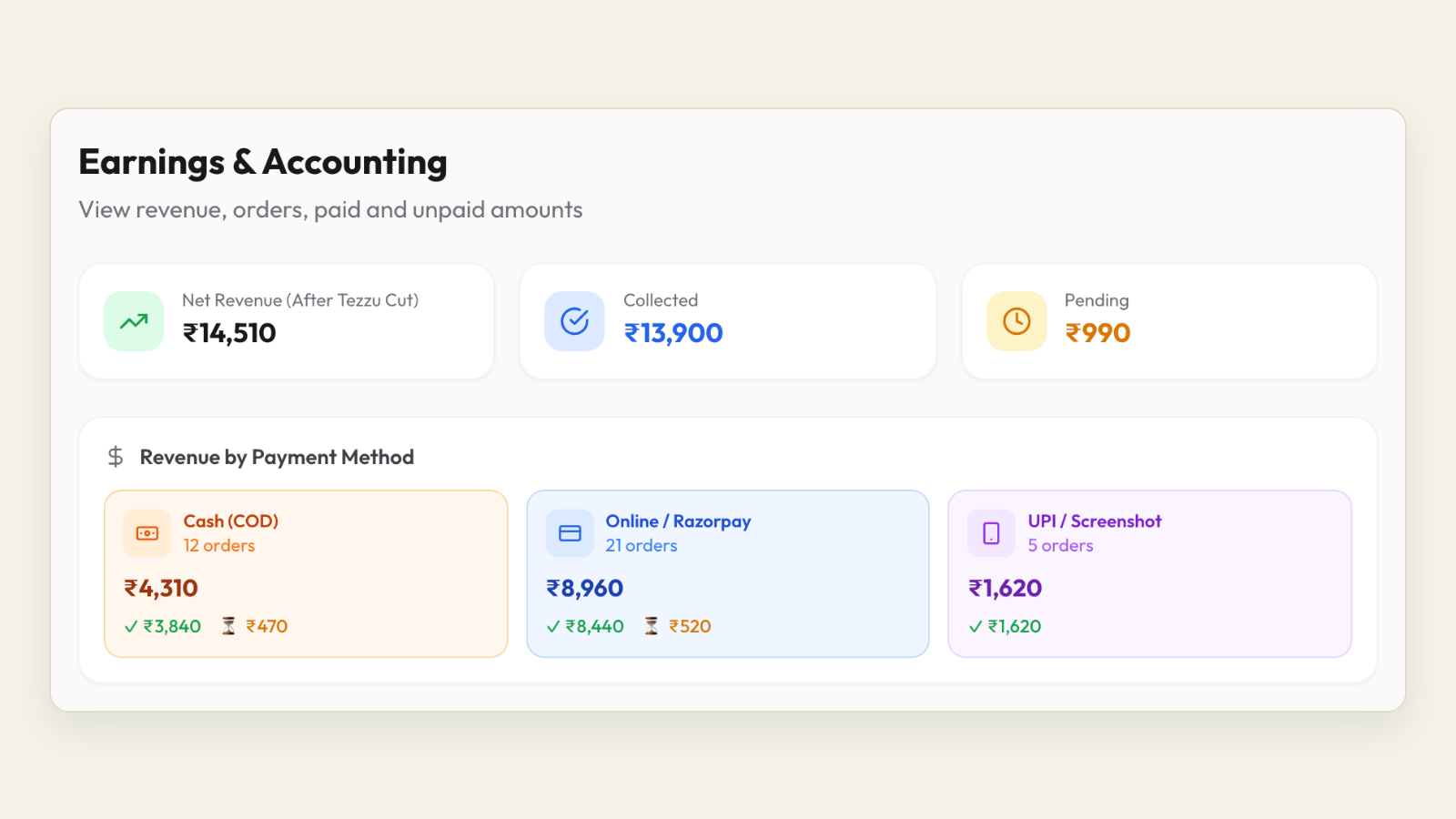
The live dashboard shows orders, revenue and customer insights, so the three numbers in this post stop being an afternoon's work with a calculator and become a glance. Delivery zones with distance-based charges and per-zone free-delivery thresholds handle the delivery pricing. UPI and card payments run through Razorpay, and you can connect your own Razorpay account for zero platform fee on payments. Cash on delivery is supported for customers who prefer it.
The cost model is the opposite of commission: Starter at ₹999 a month, Growth at ₹1,999, Enterprise at ₹3,999, with ₹10 per order and unlimited orders. Every plan starts with a 7-day free trial, so you can run the framework with real orders before deciding anything about the delivery app.
Compare the per-order cost yourself
Put ₹10 per order next to what you keep from a delivery app order and see which number your margin prefers.
See pricingFrequently asked questions
Are restaurants really leaving the delivery apps?
Some are, and many more are reducing their dependence without fully leaving. The common pattern is a restaurant that keeps the listing for new customers, stops funding discounts, and moves regulars to WhatsApp or its own store page. Full delisting is more common among established neighbourhood restaurants, tiffin services and caterers whose customers already know them.
Will I lose customers if I quit food delivery apps?
You will lose the customers who only ever found you through the app and never learned your name. You keep everyone who has your number. The size of each group is what the three numbers in this post measure, which is why you should count before you decide rather than guess.
Can I leave the delivery app but stay on the delivery app?
Yes, and it is a reasonable halfway step. Compare the two on commission terms, order volume and the quality of orders in your area, and keep the one that performs better while you build your direct channel. Both run similar partner agreements, so the exit process is the same on either side.
How long should I wait after setting up direct ordering before leaving?
Long enough that a meaningful share of your regulars have placed at least one direct order, usually six to twelve weeks of packaging inserts and reminders. Watch the aggregator share drop in your own numbers. When it crosses below roughly 40 percent and you have a delivery answer in place, you are ready.