A local meat delivery business lives or dies on three things: the customer trusts the source, the chicken or fish arrives cold and clean within a couple of hours, and reordering next Sunday takes ten seconds. The large meat apps have spent heavily on the first two. A neighbourhood butcher or fish seller with a WhatsApp number can match them on all three within a 5 km radius, and usually beats them on price and on knowing what the customer wants.
This guide covers how to set that up: the licences and hygiene rules, the cold chain, how to turn cuts and weights into a menu that customers can order without a phone call, cut-off times, delivery zones, payment rules that avoid fake screenshots, and the weekly rhythm that makes customers come back.
Why local meat delivery works alongside the big apps
The large meat delivery apps built the category, taught customers to order chicken on a phone, and proved that cleaned, weighed, vacuum-packed cuts command a premium. They also run on central processing and a courier fleet, which means a fixed cut list, limited fresh fish, and prices that carry the cost of all that infrastructure.
A local seller offers what the apps cannot: today's catch from the market at 6 am, a goat cut exactly the way a family wants it for a Sunday curry, a specific weight, and a delivery in 90 minutes by someone the customer has met. In cities with strong regional preferences for fish and mutton, that local knowledge is the business.
What the local seller usually lacks is a system. Orders come by phone and free-text WhatsApp, weights get argued over, payment arrives as a screenshot that may or may not be real, and Sunday morning is chaos. The rest of this guide is about fixing that without changing what makes the business good. The same approach works for a kirana or grocery store taking orders on WhatsApp.
Licences, sourcing and hygiene
You need FSSAI registration or a licence, depending on turnover, and your supply must come from a licensed slaughterhouse or an approved market, because municipal rules on meat sourcing are enforced more strictly than for most food categories. Local rules differ by city and state on where meat can be processed and sold, so check with the municipal health department before you start cutting at home.
Labelling matters for trust. State clearly whether chicken and mutton are halal or jhatka, the date of packing, the net weight and your FSSAI number on every pack. Customers choose a meat seller on these details more than on price.
Hygiene is a daily discipline: separate boards and knives for chicken, mutton and fish, gloves, sanitised surfaces between batches, and a cold room or deep freezer that holds between 0 and 4 degrees. Keep a simple temperature log. One photo of a clean cutting station on your store page does more for conversion than any discount.
The cold chain from market to doorstep
Buy daily, cut in the morning, and keep everything chilled until it leaves. Pack each order in a sealed food-grade bag, then an insulated delivery bag with gel ice packs. A delivery that takes under two hours from cutting to doorstep in an insulated bag stays within a safe temperature in most Indian weather; longer than that needs more ice and a tighter radius.
Fish is the hardest. It should be sold the same morning it is bought and delivered in a separate insulated compartment from chicken. Many sellers run fish on a pre-order basis only: orders by 8 pm, buying at the market at dawn, delivery by 10 am. That way nothing is bought that has not already been sold.
Turn cuts and weights into a menu
The reason meat ordering by phone takes so long is that every order is a conversation about cut, cleaning, weight and preparation. A menu captures all of it before the order reaches you. Each product is an item; weights are variants; cleaning and preparation choices are add-ons.
| Item | Variants (weight) | Add-ons | Typical price |
|---|---|---|---|
| Chicken curry cut | 500 g, 1 kg | Skinless, small pieces, boneless (extra) | ₹130 to ₹160 per 500 g |
| Chicken breast boneless | 250 g, 500 g, 1 kg | Diced, marinated tandoori (extra) | ₹180 to ₹220 per 500 g |
| Mutton curry cut | 500 g, 1 kg | With bone, boneless (extra), liver added | ₹400 to ₹500 per 500 g |
| Pomfret or local fish of the day | By piece or by weight | Cleaned, sliced, whole, fillet (extra) | Market price, updated daily |
| Prawns medium | 250 g, 500 g | Deveined, shell on, shell off (extra) | ₹250 to ₹350 per 500 g |
| Sunday family pack | Fixed bundle | Choice of 1 kg chicken plus 500 g mutton plus eggs | ₹750 to ₹900 |
The Sunday pack is a bundle, and bundles are where meat sellers lift the average order from ₹300 to ₹800. A build-your-own pack with a fixed price for a choice of cuts works well for regulars. Marinated and ready-to-cook options are add-ons with a higher margin than the raw cut.
Fish prices change daily, so update the item price each morning and mark fish as a pre-order item. A note on the item, "cleaned weight is around 80 percent of listed weight", prevents the single most common complaint in this category.
Cut-off times and scheduled orders
Run the business on slots, not on demand. Orders placed by 8 pm are delivered in the 7 to 10 am morning slot; orders by 11 am go out in the 4 to 7 pm evening slot. Fish is morning slot only. Scheduled orders let the customer pick the slot at checkout, and the cutting team sees a list of exactly what to prepare for each slot instead of a wall of chats.
Set capacity per slot. If your team can cut and pack 60 orders in a morning, cap the morning slot at 60 and let the system close it. Sunday is usually double a weekday, so plan an extra hand and an extra rider. The slot mechanics, including how customers choose a window, are covered in scheduled delivery and pre-orders.
Delivery zones, charges and minimum order
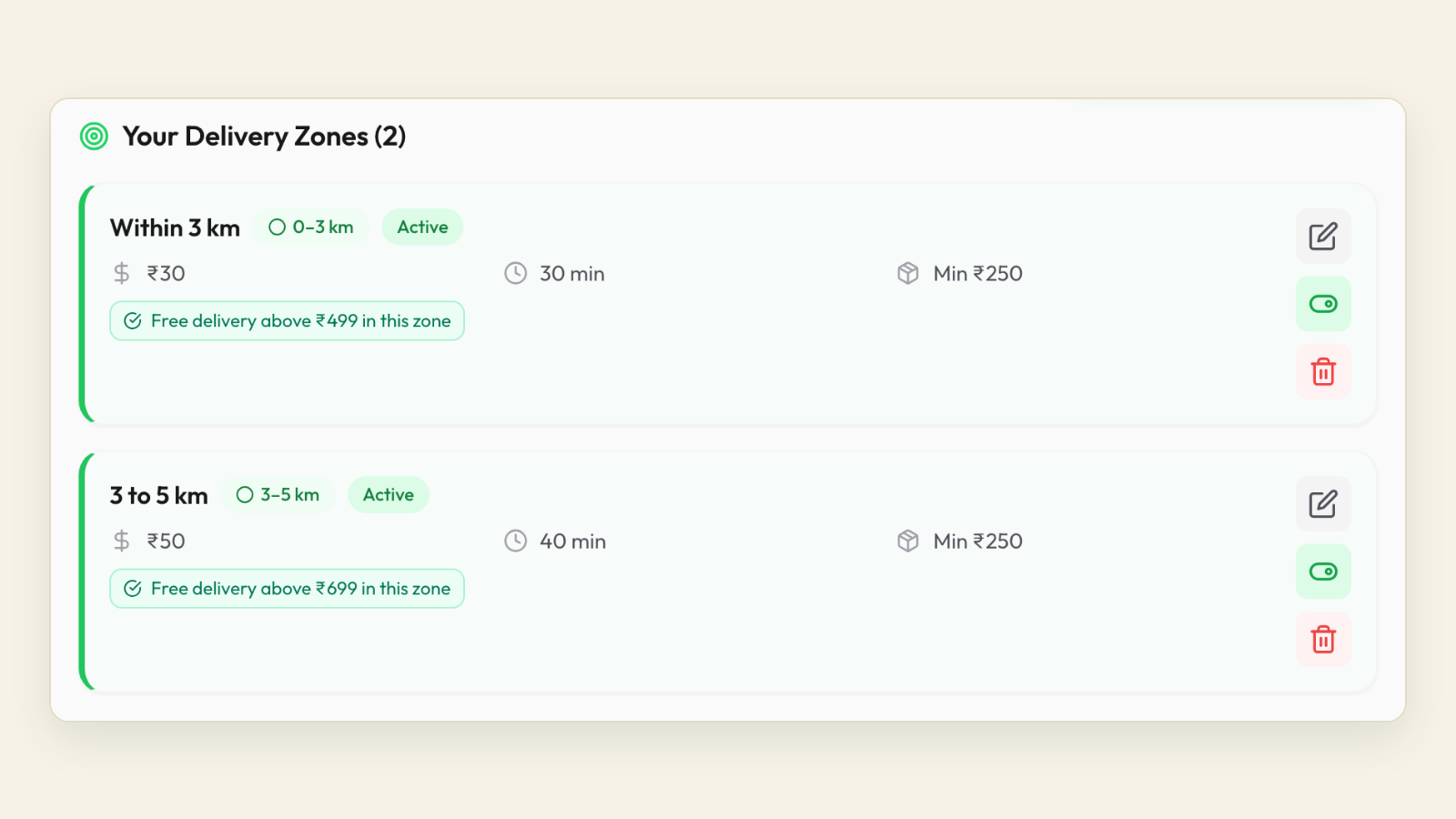
Keep the radius tight because of the cold chain. A 0 to 3 km zone at ₹30, free above ₹499, and a 3 to 5 km zone at ₹50, free above ₹699, is a common structure. Beyond 5 km, do not deliver, or deliver only in the morning slot with extra ice. A minimum order of ₹250 stops a single pack of eggs from costing you a rider trip.
The free-delivery threshold does real work in this category. A customer with ₹420 of chicken in the cart adds 12 eggs to cross ₹499, and the eggs cost you less than the delivery would have. Distance-based zones with their own thresholds are explained in how to set delivery zones and charges by distance.
Payment: prepaid by default, cash by exception
Meat is perishable and a refused delivery is a full loss, so prepaid UPI should be the default. Cash on delivery can stay on for known regulars and for orders under ₹300, but turn it off for new numbers and for Sunday slots when the cost of a no-show is highest.
Never accept a payment screenshot as proof. Edited screenshots are a known problem in every category where the product is delivered before anyone checks the bank, and meat sellers get targeted because a ₹900 pack of mutton resells easily. Use a payment link or a gateway that confirms the payment to you automatically. The common scams and the checks that stop them are in how restaurants verify UPI payments.
Weekly khata customers, usually families and small restaurants, can be handled with a weekly invoice and a payment link every Monday. Keep that list short and only for customers with a long history.
The weekly rhythm that brings customers back
Meat buying is a routine. Most families buy chicken once or twice a week and mutton on Sunday. A Saturday evening message, "Sunday slots are open, fresh mutton and pomfret in stock", sent to customers who have agreed to receive it, fills the Sunday morning slot before you have bought a single kilo. A Thursday message does the same for the weekend fish.
Post the day's fish on WhatsApp Status every morning with the price. Ask for a rating after each delivery and fix problems the same day. A customer who has not ordered in three weeks gets a short message with a ₹50 coupon on the next Sunday pack. These three habits, done every week, matter more than any launch offer.
What this looks like on Tezzu
On Tezzu, your meat shop takes orders on your own WhatsApp number and on a free store page at tezzu.in/store/your-shop. Each cut is an item with weights as variants and cleaning or marination choices as add-ons, and the Sunday pack is a bundle, including build-your-own bundles where the customer chooses the cuts. Menu scheduling can show fish only in the morning slot, and you update market prices from the dashboard each day.
Scheduled orders let the customer pick the morning or evening slot, and the live dashboard lists what to cut for each slot. Delivery zones carry distance-based charges with a per-zone free-delivery threshold, so the 3 km and 5 km zones above are a few minutes of setup; the step-by-step is in delivery zones and free-delivery thresholds in Tezzu. Payments run on UPI and cards through Razorpay with automatic confirmation, cash on delivery can be switched on or off, and you can connect your own Razorpay account for zero platform fee on payments. The staff app sounds an alert for each new order so the cutting team hears it with gloves on, reviews are collected after delivery, and WhatsApp campaigns with a prepaid wallet send the Saturday reminder. Plans start at ₹999 a month with a flat ₹10 per order and no commission. For other home and local food formats that use the same setup, see home food business ideas that work on WhatsApp.
Run your Sunday slot from your own WhatsApp number
Cuts, weights, slots, prepaid UPI and short delivery zones, with no commission on any order.
See how it works for small food businessesFrequently asked questions
What licence do I need for a meat delivery business in India?
FSSAI registration or a licence depending on your turnover, plus compliance with municipal rules on meat sourcing, which require supply from licensed slaughterhouses or approved markets. Some cities restrict where meat can be processed and sold, so check with the local health department. Label packs with halal or jhatka, packing date, weight and your FSSAI number.
How do I keep chicken and fish fresh during delivery?
Cut in the morning, hold at 0 to 4 degrees, pack in sealed bags inside an insulated delivery bag with gel ice packs, and deliver within two hours of cutting. Keep fish in a separate compartment and sell it the same morning it is bought. Limit the delivery radius to 5 km so trips stay short.
Should a meat shop accept cash on delivery?
Only for known regulars and small orders. Meat is perishable, so a refused delivery is a complete loss, and payment screenshots can be faked. Make prepaid UPI the default, confirmed automatically through a payment link or gateway, and switch cash on delivery off for new customers and for busy Sunday slots.
How do I take meat orders on WhatsApp without endless calls?
Put cuts, weights and cleaning options into a menu the customer taps through, so the order arrives complete. Use delivery slots with cut-off times so the cutting team works from a list, and collect payment at checkout. The conversation then only happens when something is genuinely unusual, such as a special cut for a function.