Using a courier for packaged food makes sense when the product is sealed, shelf-stable for at least a week, and the customer is in another city. It does not make sense for hot meals, for anything that needs a fridge, or for a customer three kilometres away who wants lunch. A courier service picks the box up from your kitchen or home and moves it across India over two to seven days, and a courier aggregator lets you book that parcel with one of several courier companies from a single account.
This post explains which food products fit, how the pricing works, what goes wrong, and how to take intercity orders on WhatsApp while you book the courier yourself. If your question is about riders within your own city, that is a different service entirely; start with the hyperlocal delivery guide instead.
What a courier aggregator actually does
A courier aggregator does not own trucks or riders. It sits between you and several courier companies, and gives you one account, one rate card, one pickup request and one tracking page across all of them. You create a shipment with the customer's address, choose a courier from the options it shows for that route, print the label, and a courier collects the parcel from your kitchen or home. You can also open an account with a single courier company directly, which suits a seller with steady volume on a few routes.
For a small food business an aggregator is useful in three ways. You get courier rates without a volume contract of your own. You can offer cash on delivery, with the collected cash remitted to you on a cycle. And you get a tracking link you can forward to the customer.
Which packaged food you can send by courier
The courier companies set the rules, and they differ, but the pattern is consistent. Couriers accept sealed, non-perishable, non-liquid goods that survive a week in a warehouse at room temperature. They refuse or restrict fresh food, items needing refrigeration, and often liquids and oils, especially by air.
| Product | Ships well | Watch out for |
|---|---|---|
| Dry sweets: soan papdi, dry-fruit mithai, laddoos with shelf life | Yes | Shelf life must cover transit plus a buffer; ghee-rich sweets go rancid in heat |
| Namkeen, chips, murukku, mixture | Yes | Crushing; use rigid outer boxes and fill the voids |
| Cookies, rusk, tea cakes, dry cakes | Yes | Breakage and staleness; nitrogen-flushed or vacuum packs help |
| Spice mixes, masalas, tea, coffee | Yes | Aroma leakage; double seal |
| Pickles, chutneys in oil | Sometimes | Treated as liquid by some couriers; PET jars, sealed and bagged, surface mode only |
| Ghee, oils, syrups | Restricted | Often refused by air; check per courier before listing |
| Chocolates | Seasonal | Melt in summer; ship in cooler months or with insulated packs |
| Fresh sweets, cakes with cream, cooked meals, meat | No | Perishable; needs a cold-chain courier, which is a different and far costlier service |
If your product is in the first four rows, a courier is a sensible route. If it is in the pickle and ghee rows, test one shipment on a surface courier before you promise anything to customers. The packaging and labelling rules for each type are in shipping homemade food across India.
What it costs to ship packaged food in India
Courier pricing is by weight slab and by distance zone, and both can surprise you.
Weight slabs
Rates are quoted per 500 g slab. A 600 g parcel is charged as 1 kg. Couriers also apply volumetric weight, calculated from the box dimensions, and charge whichever is higher. A light but bulky box of namkeen can be billed at 2 kg when it weighs 700 g. Most courier and aggregator accounts have a rate calculator that shows both numbers; use it before you set a shipping charge for customers.
Distance zones
Couriers price in zones: within the city, within the region or state, between metros, the rest of India, and special zones such as the North East and Jammu and Kashmir. The same 1 kg box costs noticeably more to the special zones and to remote pincodes. Check the serviceable pincode list before accepting an order from a new area.
Mode and extras
Surface is cheaper and slower than air, and more permissive about what it carries. Cash on delivery adds a per-parcel COD charge and the cash is remitted on a cycle rather than instantly. A failed delivery that comes back to you is charged as a return, usually at a similar rate to the outbound leg. Exact rates depend on the courier and, if you use an aggregator, on your plan with it; the rate card in your account is the only reliable source, so quote it rather than a number from a blog.
As a working assumption for planning, a 1 kg box between two Indian metros on surface tends to cost tens of rupees rather than hundreds, and the special zones cost two to three times that. Build the shipping charge for the customer from the calculator for their pincode, or set a flat charge that covers your average parcel and absorb the difference.
Where it goes wrong, and how to avoid it
- Underpacked boxes. The courier network is not gentle. A box should survive being dropped from waist height. Use a rigid corrugated outer box, bubble wrap or crumpled paper in every gap, and seal the product inside a food-grade bag before it goes in the box.
- Shelf life eaten by transit. A sweet with a ten-day life that takes six days to arrive leaves the customer four days. Ship only products with at least two weeks of life, and print the manufacturing and best-before dates clearly.
- Wrong pincode or phone. The single biggest cause of failed deliveries and return charges. Confirm both with the customer in writing before you book.
- COD without a deposit. A customer who refuses a COD parcel costs you the product plus two courier legs. For food, take payment in advance; UPI at the time of ordering removes the risk.
- Pickup not scheduled. Creating the shipment does not fetch the parcel. Request pickup for the same or next day, and keep the parcel ready at the door.
For general packaging principles that apply to both hot delivery and courier boxes, see food delivery packaging.
Taking courier orders on WhatsApp
Most home food businesses that ship across India take the order on WhatsApp and then re-type it into the courier's booking page. That works at five orders a week. At thirty it means thirty addresses pieced together from chat messages, thirty chances of a typo, and thirty payment screenshots to match against orders.
The cleaner flow is to take the order on a system that captures the full address, phone number and payment up front, so every courier booking starts from one complete record. The customer picks the product from your menu, pays by UPI, and the order arrives with the details the courier label needs. You still book the parcel yourself on your courier or aggregator account, but you copy from a clean order instead of scrolling back through a chat. The selling side of this, for pickles, papad and other homemade products, is covered in how to sell pickles, papad and homemade food online.
What this looks like on Tezzu
Tezzu takes the order and the payment; the courier booking stays with you. Your products, variants and bundles sit in a WhatsApp ordering bot on your own number and on your free store page at tezzu.in/store/your-name, so customers can browse and choose. Orders that go through checkout are paid by UPI or card through Razorpay and land in the live dashboard and on the staff app with the customer's name, phone number and address. If you use delivery zones, an address in another city may not be accepted at checkout; for those boxes, confirm the order, the address and the payment with the customer directly.
Tezzu does not connect to any courier service. When a box needs to travel to another city, you book it on whichever courier or aggregator you use and share the tracking link with the customer yourself. For your local orders, delivery zones with distance-based charges and per-zone free-delivery thresholds do the pricing.
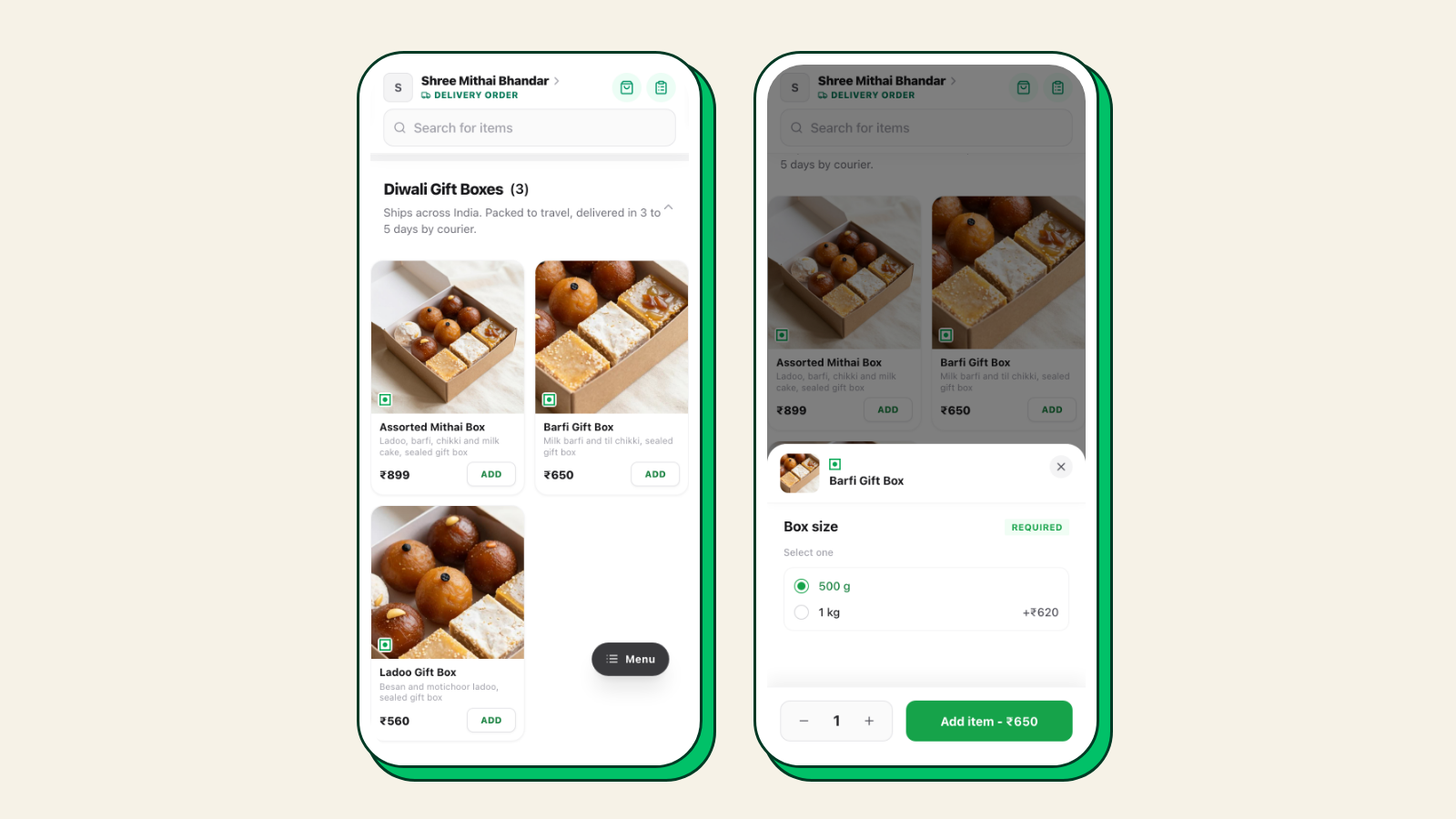
Plans start at ₹999 a month with a flat ₹10 per order and no commission, and every plan starts with a 7-day free trial. Courier charges are between you and your courier, outside Tezzu.
Take the order and payment on WhatsApp
Start a free 7-day trial, put your shelf-stable products on your store page, and take a paid test order before you book your first courier.
Start your free 7-day trialFrequently asked questions
Can I send food by courier in India?
Yes, if the food is sealed, non-perishable and shelf-stable at room temperature, such as dry sweets, namkeen, cookies, spice mixes and tea. Courier companies refuse or restrict fresh food, refrigerated items and often liquids and oils, so pickles and ghee need a surface courier and a test shipment before you list them.
How much does it cost to ship packaged food in India?
It depends on the courier, the weight slab in 500 g steps, volumetric weight, and the distance zone between your pincode and the customer's. Cash on delivery and failed-delivery returns add extra charges. The rate calculator in your courier or aggregator account is the reliable source; check it per pincode rather than trusting a figure from a blog, and build the cost into your box price or shipping charge.
How long does courier delivery of food take in India?
Between metros on surface, usually two to four days; to smaller towns and special zones, four to seven days or more. Air is faster but carries fewer food categories. Plan shelf life around the slow end of the range rather than the fast end, and tell the customer the expected window when you confirm the order.
What is the best courier for homemade food?
For a home kitchen sending a few parcels a week, a courier aggregator is usually the simplest start, because one account lets you compare couriers per route without negotiating with each courier company. The right courier is the one that services the customer's pincode, accepts your product and arrives well within its shelf life. The work that remains is yours: sturdy packaging, correct labelling under FSSAI rules, and taking payment before the parcel leaves.